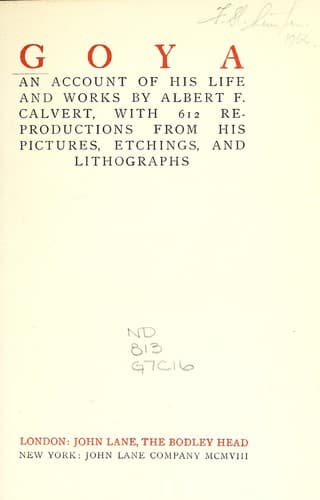
Goya, an account of his life and works — John Shaqi
Goya, an account of his life and worksCalvert, Albert Frederick
History
Goya, an account of his life and works
Calvert, Albert Frederick
Goya, Francisco, 1746-1828
Italy in his old age was of his having met there the painter of “The
Rape of the Sabines.”’
The friendship that existed between Goya and David has called attention
to the similarities in the temperament and the aims of the two men,
whose work was so widely different. Both used their brushes to glorify
the throne and received honours from kings; both sacrificed tradition on
the altar of new ideas; and both lacked the tenderness and the faith
necessary in the treatment of religious subjects. David was the friend
of Robespierre and Saint Just, of Marat and Buonaparte; he painted the
‘Coronation of the Hero of the Pyramids’; he attended the Convention and
voted for the death of Louis XVI. Goya was the friend of Godoy and of
the ministers of Joseph Buonaparte; he painted the pictures of the
Usurper as well as those of the kings that preceded and followed him;
and he executed ‘The Disasters of War’ and ‘The Caprices.’ David was
ambitious for the aggrandisement of his art, and Goya strove to make it
worthy of its civilising mission, but they differed in the means by
which they sought to attain their respective ends. David was inspired by
the antique, and produced works which possessed the hardness of statuary
as well as its clear-cut accuracy of form, while Goya went direct to
nature for his inspiration, and his paintings are the reflections of
naked reality. The painter of ‘The Death of Socrates’ was imbued with
the guiding purpose of making his work dignified, elaborately accurate,
and exclusive, while the author of the frescoes of La Florida, drawing
inspiration from the customs of the toilers and the dandies alike, held
that ‘a picture is finished when its effect is true.’ David represented
man endowed with improbable and unattractive virtues, Goya painted man
as he was; David idealised the individual form with classic grandeur,
and his austere and solemn compositions, though based on observation of
nature, were moulded to a fixed external idea; but Goya was as faithful
to psychologic truth as to anatomy, and his brush revealed the moral
sentiments of mankind and laid bare the passionate and terrible emotions
of the human soul.
Public-domain text, read in full here on John Shaqi.
Reviews
Reviews
No reviews yet
Be the first to share your thoughts on this work.
Join the Discussion
Join the discussion
Sign in to leave a comment or review.
Sign InorCreate an account