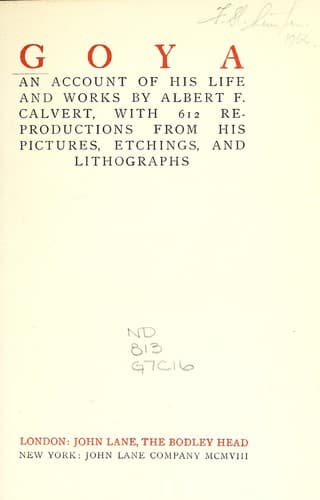
Goya, an account of his life and worksCalvert, Albert Frederick
History
Goya, an account of his life and works
Calvert, Albert Frederick
Goya, Francisco, 1746-1828
When Goya returned to Madrid in 1775 Spanish art was directed by Mengs
and Tiepolo, by Maëlla and Francesco Bayeu. Mengs, the ‘reasoning
artificer,’ who had neglected the world of nature in his servile study
of Raphael and the antique, was a painter who theorised much and
invented little. According to Richard Cumberland he was an artist
incapable of portraying either life or death; a painter whose creations
neither terrify nor inspire passion or transport; a timid, conscientious
craftsman with an excellent hand for miniature. Yet Mengs, the ‘Spanish
David,’ as we are told by José de Madrazo, was regarded by the youth of
his time as ‘the regenerator of the antique,’ and from the dictatorial
chair of pictorial art, his voice ‘was heard like that of an oracle, not
so much by the artistic cohorts of agitated Germany, where he received
little attention, as by the peaceful Italo-Spanish pleiades, who
applauded with enthusiasm the exhumation of the Hellenic form from among
the ruins of Herculaneum and Pompeii, because it was the fashion, and
without comprehending the reach of that fortuitous event.’
In the fantastic, beautiful, but slightly handled compositions of
Battista Tiepolo we have the reaction against this form of classicism.
The Venetian possessed a fertile and brilliant fancy, his execution was
free and daring, if at times careless, and, in addition, he had a wide
knowledge of the resources of his art. His decorations in the new palace
at Madrid were ‘extolled to the skies of a generation that had forgotten
Velazquez.’ Tiepolo got his effects rapidly; Mengs was laborious to a
fault, but his work was probably a better guide for second-rate
painters, themselves poorly equipped in knowledge, than the clearly
(though incorrectly) drawn compositions of his Venetian contemporary.
As director of the Académia de San Fernando, Mengs suggested several new
laws for the government of the students and certain alterations in the
methods of study. These were at first adopted, but in carrying them into
effect the director seems to have met with opposition and involved
himself in quarrels, which ‘did little credit to the wisdom of his
fellow-directors, or to his own temper and tact.’ As a result of these
dissensions Mengs failed to accomplish all his reforms, but he secured
several important changes in the Academy. It was due to his efforts that
plaster casts were taken of the statues discovered at Herculaneum.
Charles III. dowered the institution with a rich collection of marbles
and bronzes which had been presented to his Majesty by Mengs, and he
supplemented this gift with a large number of statues and busts from the
Museum of Cristina of Sweden, and with pictures from the royal galleries
and from the suppressed houses of the Jesuits. The sovereign also formed
a library for the Academy, opened a school of perspective (Royal Decree
of August 19, 1766), and commissioned the surgeon Augustin Navarro to
Public-domain text, read in full here on John Shaqi.
Reviews
Reviews
No reviews yet
Be the first to share your thoughts on this work.
Join the Discussion
Join the discussion
Sign in to leave a comment or review.
Sign InorCreate an account