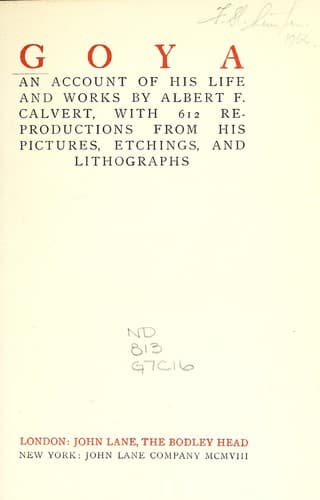
Goya, an account of his life and worksCalvert, Albert Frederick
History
Goya, an account of his life and works
Calvert, Albert Frederick
Goya, Francisco, 1746-1828
instruct the students in the science of nature and the human form.
In his efforts on behalf of the Academy, Mengs had the loyal assistance
of Francisco Bayeu and Mariano Maëlla. The latter’s pictures are
deficient in invention, in vigour of execution, and in variety; indeed
his cold pearl-coloured creations have nothing to compensate their
feeble and unimpressive handling and colour. Bayeu was gifted with
peculiar intelligence and as an artist displayed fertility, capacity in
composing a picture, and a skilful touch, but his designs lack vigour
and delicacy, and his colour is disagreeable.
When Goya reappeared in Madrid in 1775, Mengs was dictator of art, and
Bayeu was the Court painter. Goya’s art owed nothing to contemporary
influence or example, but to these two officials he was indebted for
employment and for his wife. The young Aragonese knew nothing of the
bitterness of long apprenticeship; his rise in the esteem of the art
world of Madrid was rapid. This, in a measure, was due to his genius,
but his worldly prospects were assisted by his marriage to Josefa Bayeu,
the sister of the Court painter, and by the influence of Mengs, which
secured for him a commission to execute a series of designs for the
tapestries woven at the Fábrica de Tapices de Santa Bárbara. This first
series were designed for the decoration of the dining-room and
bed-chamber of the Prince of the Asturias in the Palace of El Pardo.
Goya delivered the first picture on October 31, 1776; on January 26,
1778, the tenth and last cartoon was delivered.
Between 1776 and 1791 Goya executed the forty-six tapestry cartoons
which now hang in the Prado, and he repainted many of his designs on a
smaller scale for the Countess of Benavente at the Alameda. As late as
1802 the Santa Bárbara factory wove tapestries from Goya’s pictures, and
up to 1832 some of the more favoured designs had been reproduced four
times. Isabella II. presented some of these fabrics to King Leopold of
Belgium, but the greater number adorn the royal palaces of Madrid, El
Pardo, and the Escorial.
Public-domain text, read in full here on John Shaqi.
Reviews
Reviews
No reviews yet
Be the first to share your thoughts on this work.
Join the Discussion
Join the discussion
Sign in to leave a comment or review.
Sign InorCreate an account