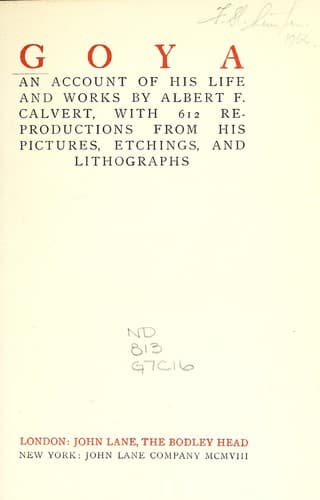
Goya, an account of his life and worksCalvert, Albert Frederick
History
Goya, an account of his life and works
Calvert, Albert Frederick
Goya, Francisco, 1746-1828
It has been claimed for Goya that his genius was arrogantly
unsubjective; that he had no master and was contemptuous of all rules.
Originality and independence could go no further, and it may be admitted
that he was intolerant of outside influence. But the spark of genius
must be fanned into flame by the magnetic influence of example, and
while Goya studied nature with a passionate and jealous devotion, he
glories in the debt he owes to Rembrandt and Velazquez. ‘I have had
three masters,’ he wrote to a literary friend, ‘Nature, Velazquez, and
Rembrandt.’ Some have tried to recognise in him a disciple of Tiepolo,
and his study of the aquafortis engravings of the Venetian may well have
suggested his adoption of that so long neglected method of engraving,
but as we should expect, he preserved an independent attitude of mind
and developed a manner quite different from that of Tiepolo. There is no
evidence, in his engravings, of any admiration for Tiepolo’s style, but
his admiration of Rembrandt was as sincere as was his devotion to
Velazquez. Gautier finds that Goya’s work reminds one of Velazquez and
Rembrandt, ‘as a son reminds you of his ancestors, without any servile
imitation--or rather, more by certain congeniality of taste than by any
formal wish.’ ‘Goya’s love for the old masters,’ says Lafond, ‘is the
best proof one can give of his sincerity. He did not think of inventing
new processes; conscious that the same language is capable of a variety
of expressions, he was content to master the technique of the past and
to borrow from it all that best suited his individuality.’ But what he
borrowed he moulded and modified to suit his own purposes; translating
it into a language which was his own and in the process enlarging it
with new and further life.
In 1779 Goya presented to the King his plates after the pictures of
Velazquez. This series, which consisted of the portraits of Philip III.,
Philip IV., Margaret of Austria, Isabella of Bourbon, Prince Baltasar
Carlos, the Count-Duke of Olivarez, and other etchings, are faithful
though not inspired copies of the master. Goya wrote to Zapater that he
had had the honour of being received by his Majesty and family when he
submitted the plates for their inspection, and he adds, ‘I could not
have wished them to be more pleased than they showed themselves to be on
seeing them.’
Public-domain text, read in full here on John Shaqi.
Reviews
Reviews
No reviews yet
Be the first to share your thoughts on this work.
Join the Discussion
Join the discussion
Sign in to leave a comment or review.
Sign InorCreate an account