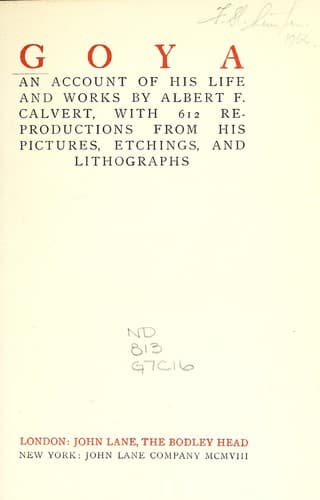
Goya, an account of his life and worksCalvert, Albert Frederick
History
Goya, an account of his life and works
Calvert, Albert Frederick
Goya, Francisco, 1746-1828
Goya’s position was rendered acutely difficult by these drastic changes.
The first painter of the exiled King, the favourite of his dispersed
courtiers, what could he do in the court of the hated Joseph Buonaparte?
It may be surmised that ‘the good old Goya,’ as Gautier familiarly
styles him, hated the new order of things, but he was no visionary
patriot burning with the fire of useless sacrifice. His love of country
was not love of Charles IV. or his son; he loved Spain not less because
Maria Luisa and Godoy were out of it. And as he asked himself what
action he should take, he saw the Prince of the Asturias submit himself
to the new ruler, and with him Jove-Llanos, Mazarrado and Urquijo, the
Dukes of Fernan Nuñez and del Parque, the Count of Santa Colonna, the
Cardinal of Bourbon--to mention a few only among the nobles. Goya’s
comrades also, the Court painters, Mariano Maëlla, Francisco Ramos, and
Pablo Racio, acknowledged the ‘intrusive king’! Goya hesitated no
longer. He took the oath of allegiance to Joseph I. He was made a knight
of the Legion of Honour. He painted the usurper’s portrait, and some
time later accepted, with Napoli and Maëlla, the commission to select
from the treasures of the royal gallery fifty of the most beautiful
pictures which were to be sent to the Louvre.
But though the old order had changed and Goya had changed with it, his
spirit was full of bitterness. He had witnessed the butchery and
slaughter of the French soldiers; he hated the sound of the clanking of
the spurs of Murat’s hussars on the pavements of Madrid.
Public-domain text, read in full here on John Shaqi.
Reviews
Reviews
No reviews yet
Be the first to share your thoughts on this work.
Elsewhere in the archive
Join the Discussion
Join the discussion
Sign in to leave a comment or review.
Sign InorCreate an account