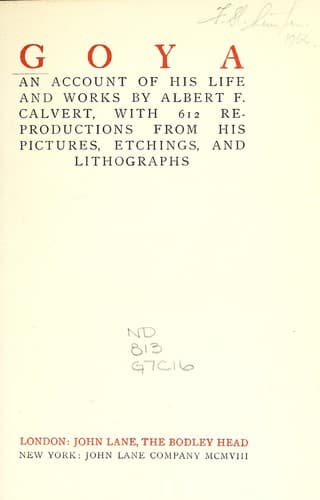
Goya, an account of his life and worksCalvert, Albert Frederick
History
Goya, an account of his life and works
Calvert, Albert Frederick
Goya, Francisco, 1746-1828
Already he had painted two pictures, the ‘Dos de Mayo’ and ‘Un Episodio
de la Invasión Francesca.’ One has only to study these two pictures of
realised terror, in the Prado, to understand the painter’s hatred of the
French and the brooding melancholy which the events of the rising in
Madrid had fastened upon his soul and darkened his life. De Amicis, the
Italian author, writes, with a fine appreciation of the stirring realism
of these works: ‘Nothing more tremendous can be imagined: one can give
no more execrable form to power, nor frightful aspect to desperation,
nor a more ferocious expression to the fury of a fray. In the first one
there is a dark sky, the light of a lantern, a pool of blood, a pile of
bodies, a crowd of men condemned to death, and a line of French
soldiers in the act of firing; in the other are horses with their veins
cut, and horsemen dragged from their saddles, stabbed, trodden upon, and
lacerated. What faces! What attitudes! One seems to hear the cries and
see the blood running: the veritable scene could not cause more horror.
Goya must have painted these pictures with his eyes glaring, foam at his
mouth, and with the fury of a demoniac; it is the last point which
painting can reach before being translated into action; having passed
that point one throws away the brush and seizes the dagger; one must
commit murder in order to do anything more terrible than those pictures;
after those colours, comes blood.’
Goya retired to the seclusion of his house outside the gates of the
capital, only opening his doors to a few old friends, among whom were
Cean Bermudez the art critic, Carnicero the illustrator of _Don
Quixote_, Castillo the painter, and Selma the engraver. The old painter
had become completely deaf, and, in these dark days of change and
violence, the bitterness of his spirit found further expression in the
‘Desastres de la Guerra’--‘the cry of a just soul against the iniquity
of warfare.’ With passionate vigour he depicted the horrors of the
French invasion and lashed with his satire the barbarities of the
conquerors. The new series was begun in the year 1810. They reproduce
all the sad and abominable events which had culminated in the accession
of Joseph Bonaparte. Callot, in his scenes of the barbarities of the
Thirty Years’ War, did not attain the fire, the power, or the purpose of
these plates. All the horrors of warfare and its heroism and the
stupidity of war are depicted here with searching truth. The technique
of the plates is unsurpassed. We see starving men made bestial with
terror, dead bodies stripped and mutilated, women outraged, and children
butchered before the eyes of their frenzied mothers. And again we are
shown the superb heroism of the women who, armed only with hatchets and
stones, withstood the onslaught of the dragoons; we are made to realise
the intrepid loyalty of those men and women who fought side by side on
the terrible Dos de Mayo; we witness the masculine daring of the women
Public-domain text, read in full here on John Shaqi.
Reviews
Reviews
No reviews yet
Be the first to share your thoughts on this work.
Elsewhere in the archive
Join the Discussion
Join the discussion
Sign in to leave a comment or review.
Sign InorCreate an account