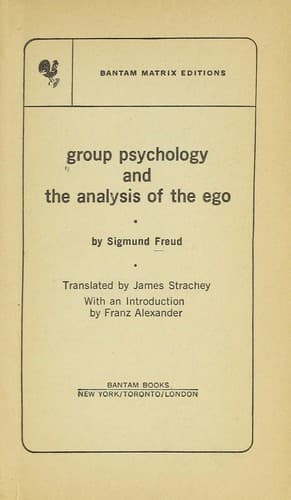
Group Psychology and The Analysis of The EgoFreud, Sigmund
Science
Group Psychology and The Analysis of The Ego
Freud, Sigmund
Ego (Psychology); Psychoanalysis; Social psychology
We are of opinion, then, that language has carried out an entirely
justifiable piece of unification in creating the word 'love' with its
numerous uses, and that we cannot do better than take it as the basis of
our scientific discussions and expositions as well. By coming to this
decision, psycho-analysis has let loose a storm of indignation, as
though it had been guilty of an act of outrageous innovation. Yet
psycho-analysis has done nothing original in taking love in this 'wider'
sense. In its origin, function, and relation to sexual love, the
'_Eros_' of the philosopher Plato coincides exactly with the love force,
the libido, of psycho-analysis, as has been shown in detail by
Nachmansohn and Pfister;[25] and when the apostle Paul, in his famous
epistle to the Corinthians, prizes love above all else, he certainly
understands it in the same 'wider' sense.[26] But this only shows that
men do not always take their great thinkers seriously, even when they
profess most to admire them.
Psycho-analysis, then, gives these love instincts the name of sexual
instincts, a _potiori_ and by reason of their origin. The majority of
'educated' people have taken their revenge by retorting upon
psycho-analysis with the reproach of 'pan-sexualism'. Anyone who
considers sex as something mortifying and humiliating to human nature is
at liberty to make use of the more genteel expressions 'Eros' and
'erotic'. I might have done so myself from the first and thus have
spared myself much opposition. But I did not want to, for I like to
avoid concessions to faint-heartedness. One can never tell where that
road may lead one; one gives way first in words, and then little by
little in substance too. I cannot see any merit in being ashamed of sex;
the Greek word 'Eros', which is to soften the affront, is in the end
nothing more than a translation of our German word _Liebe_ [love]; and
finally, he who knows how to wait need make no concessions.
We will try our fortune, then, with the supposition that love
relationships (or, to use a more neutral expression, emotional ties)
also constitute the essence of the group mind. Let us remember that the
authorities make no mention of any such relations. What would correspond
to them is evidently concealed behind the shelter, the screen, of
suggestion. Our hypothesis finds support in the first instance from two
passing thoughts. First, that a group is clearly held together by a
power of some kind: and to what power could this feat be better ascribed
than to Eros, who holds together everything in the world? Secondly, that
if an individual gives up his distinctiveness in a group and lets its
other members influence him by suggestion, it gives one the impression
that he does it because he feels the need of being in harmony with them
rather than in opposition to them--so that perhaps after all he does it
'_ihnen zu Liebe_'.[27]
V
TWO ARTIFICIAL GROUPS: THE CHURCH AND THE ARMY
Public-domain text, read in full here on John Shaqi.
Reviews
Reviews
No reviews yet
Be the first to share your thoughts on this work.
Join the Discussion
Join the discussion
Sign in to leave a comment or review.
Sign InorCreate an account