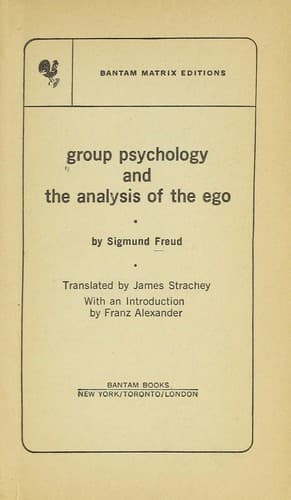
Group Psychology and The Analysis of The Ego — John Shaqi
Group Psychology and The Analysis of The EgoFreud, Sigmund
Science
Group Psychology and The Analysis of The Ego
Freud, Sigmund
Ego (Psychology); Psychoanalysis; Social psychology
We may recall from what we know of the morphology of groups that it is
possible to distinguish very different kinds of groups and opposing
lines in their development. There are very fleeting groups and extremely
lasting ones; homogeneous ones, made up of the same sorts of
individuals, and unhomogeneous ones; natural groups, and artificial
ones, requiring an external force to keep them together; primitive
groups, and highly organised ones with a definite structure. But for
reasons which have yet to be explained we should like to lay particular
stress upon a distinction to which the authorities have rather given too
little attention; I refer to that between leaderless groups and those
with leaders. And, in complete opposition to the usual practice, we
shall not choose a relatively simple group formation as our point of
departure, but shall begin with highly organised, lasting and artificial
groups. The most interesting example of such structures are
churches--communities of believers--and armies.
A church and an army are artificial groups, that is, a certain external
force is employed to prevent them from disintegrating and to check
alterations in their structure. As a rule a person is not consulted or
is given no choice, as to whether he wants to enter such a group; any
attempt at leaving it is usually met with persecution or with severe
punishment, or has quite definite conditions attached to it. It is quite
outside our present interest to enquire why these associations need such
special safeguards. We are only attracted by one circumstance, namely
that certain facts, which are far more concealed in other cases, can be
observed very clearly in those highly organised groups which are
protected from dissolution in the manner that has been mentioned. In a
church (and we may with advantage take the Catholic Church as a type) as
well as in an army, however different the two may be in other respects,
the same illusion holds good of there being a head--in the Catholic
Church Christ, in an army its Commander-in-Chief--who loves all the
individuals in the group with an equal love. Everything depends upon
this illusion; if it were to be dropped, then both Church and army would
dissolve, so far as the external force permitted them to. This equal
love was expressly enunciated by Christ: 'Inasmuch as ye have done it
unto one of the least of these my brethren, ye have done it unto me.' He
stands to the individual members of the group of believers in the
relation of a kind elder brother; he is their father surrogate. All the
demands that are made upon the individual are derived from this love of
Christ's. A democratic character runs through the Church, for the very
reason that before Christ everyone is equal, and that everyone has an
equal share in his love. It is not without a deep reason that the
similarity between the Christian community and a family is invoked, and
that believers call themselves brothers in Christ, that is, brothers
Public-domain text, read in full here on John Shaqi.
Reviews
Reviews
No reviews yet
Be the first to share your thoughts on this work.
Join the Discussion
Join the discussion
Sign in to leave a comment or review.
Sign InorCreate an account