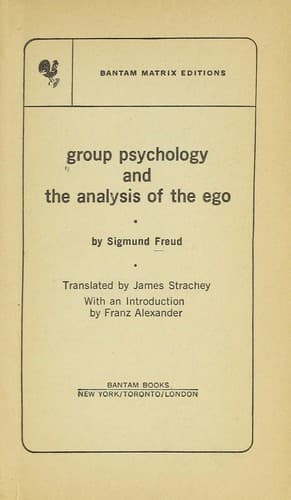
Group Psychology and The Analysis of The EgoFreud, Sigmund
Science
Group Psychology and The Analysis of The Ego
Freud, Sigmund
Ego (Psychology); Psychoanalysis; Social psychology
But our interest now leads us on to the pressing question as to what may
be the nature of these ties which exist in groups. In the
psycho-analytic study of neuroses we have hitherto been occupied almost
exclusively with ties that unite with their objects those love instincts
which still pursue directly sexual aims. In groups there can evidently
be no question of sexual aims of that kind. We are concerned here with
love instincts which have been diverted from their original aims, though
they do not operate with less energy on that account. Now we have
already observed within the range of the usual sexual object-cathexis
[_Objektbesetzung_] phenomena which represent a diversion of the
instinct from its sexual aim. We have described them as degrees of being
in love, and have recognized that they involve a certain encroachment
upon the ego. We shall now turn our attention more closely to these
phenomena of being in love, in the firm expectation of finding in them
conditions which can be transferred to the ties that exist in groups.
But we should also like to know whether this kind of object-cathexis, as
we know it in sexual life, represents the only manner of emotional tie
with other people, or whether we must take other mechanisms of the sort
into account. As a matter of fact we learn from psycho-analysis that
there do exist other mechanisms for emotional ties, the so-called
_identifications_, insufficiently-known processes and hard to describe,
the investigation of which will for some time keep us away from the
subject of Group Psychology.
VII
IDENTIFICATION
Identification is known to psycho-analysis as the earliest expression of
an emotional tie with another person. It plays a part in the early
history of the Oedipus complex. A little boy will exhibit a special
interest in his father; he would like to grow like him and be like him,
and take his place everywhere. We may say simply that he takes his
father as his ideal. This behaviour has nothing to do with a passive or
feminine attitude towards his father (and towards males in general); it
is on the contrary typically masculine. It fits in very well with the
Oedipus complex, for which it helps to prepare the way.
Public-domain text, read in full here on John Shaqi.
Reviews
Reviews
No reviews yet
Be the first to share your thoughts on this work.
Join the Discussion
Join the discussion
Sign in to leave a comment or review.
Sign InorCreate an account