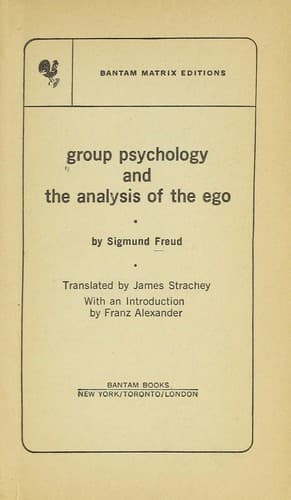
Group Psychology and The Analysis of The EgoFreud, Sigmund
Science
Group Psychology and The Analysis of The Ego
Freud, Sigmund
Ego (Psychology); Psychoanalysis; Social psychology
At the same time as this identification with his father, or a little
later, the boy has begun to develop a true object-cathexis towards his
mother according to the anaclitic type [_Anlehnungstypus_].[38] He then
exhibits, therefore, two psychologically distinct ties: a
straightforward sexual object-cathexis towards his mother and a typical
identification towards his father. The two subsist side by side for a
time without any mutual influence or interference. In consequence of the
irresistible advance towards a unification of mental life they come
together at last; and the normal Oedipus complex originates from their
confluence. The little boy notices that his father stands in his way
with his mother. His identification with his father then takes on a
hostile colouring and becomes identical with the wish to replace his
father in regard to his mother as well. Identification, in fact, is
ambivalent from the very first; it can turn into an expression of
tenderness as easily as into a wish for someone's removal. It behaves
like a derivative of the first _oral_ phase of the organisation of the
libido, in which the object that we long for and prize is assimilated by
eating and is in that way annihilated as such. The cannibal, as we know,
has remained at this standpoint; he has a devouring affection for his
enemies and only devours people of whom he is fond.[39]
The subsequent history of this identification with the father may easily
be lost sight of. It may happen that the Oedipus complex becomes
inverted, and that the father is taken as the object of a feminine
attitude, an object from which the directly sexual instincts look for
satisfaction; in that event the identification with the father has
become the precursor of an object tie with the father. The same holds
good, with the necessary substitutions, of the baby daughter as well.
It is easy to state in a formula the distinction between an
identification with the father and the choice of the father as an
object. In the first case one's father is what one would like to _be_,
and in the second he is what one would like to _have_. The distinction,
that is, depends upon whether the tie attaches to the subject or to the
object of the ego. The former is therefore already possible before any
sexual object-choice has been made. It is much more difficult to give a
clear metapsychological representation of the distinction. We can only
see that identification endeavours to mould a person's own ego after the
fashion of the one that has been taken as a 'model'.
Public-domain text, read in full here on John Shaqi.
Reviews
Reviews
No reviews yet
Be the first to share your thoughts on this work.
Join the Discussion
Join the discussion
Sign in to leave a comment or review.
Sign InorCreate an account