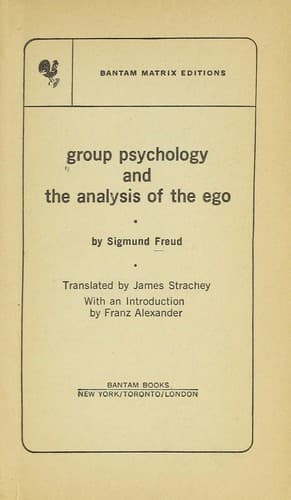
Group Psychology and The Analysis of The Ego — John Shaqi
Group Psychology and The Analysis of The EgoFreud, Sigmund
Science
Group Psychology and The Analysis of The Ego
Freud, Sigmund
Ego (Psychology); Psychoanalysis; Social psychology
Psycho-analytic research, which has already occasionally attacked the
more difficult problems of the psychoses, has also been able to exhibit
identification to us in some other cases which are not immediately
comprehensible. I shall treat two of these cases in detail as material
for our further consideration.
The genesis of male homosexuality in a large class of cases is as
follows. A young man has been unusually long and intensely fixated upon
his mother in the sense of the Oedipus complex. But at last, after the
end of his puberty, the time comes for exchanging his mother for some
other sexual object. Things take a sudden turn: the young man does not
abandon his mother, but identifies himself with her; he transforms
himself into her, and now looks about for objects which can replace his
ego for him, and on which he can bestow such love and care as he has
experienced from his mother. This is a frequent process, which can be
confirmed as often as one likes, and which is naturally quite
independent of any hypothesis that may be made as to the organic driving
force and the motives of the sudden transformation. A striking thing
about this identification is its ample scale; it remoulds the ego in one
of its important features--in its sexual character--upon the model of
what has hitherto been the object. In this process the object itself is
renounced--whether entirely or in the sense of being preserved only in
the unconscious is a question outside the present discussion.
Identification with an object that is renounced or lost as a substitute
for it, introjection of this object into the ego, is indeed no longer a
novelty to us. A process of the kind may sometimes be directly observed
in small children. A short time ago an observation of this sort was
published in the _Internationale Zeitschrift für Psychoanalyse_. A child
who was unhappy over the loss of a kitten declared straight out that now
he himself was the kitten, and accordingly crawled about on all fours,
would not eat at table, etc.[41]
Another such instance of introjection of the object has been provided by
the analysis of melancholia, an affection which counts among the most
remarkable of its exciting causes the real or emotional loss of a loved
object. A leading characteristic of these cases is a cruel
self-depreciation of the ego combined with relentless self-criticism and
bitter self-reproaches. Analyses have shown that this disparagement and
these reproaches apply at bottom to the object and represent the ego's
revenge upon it. The shadow of the object has fallen upon the ego, as I
have said elsewhere.[42] The introjection of the object is here
unmistakably clear.
Public-domain text, read in full here on John Shaqi.
Reviews
Reviews
No reviews yet
Be the first to share your thoughts on this work.
Join the Discussion
Join the discussion
Sign in to leave a comment or review.
Sign InorCreate an account