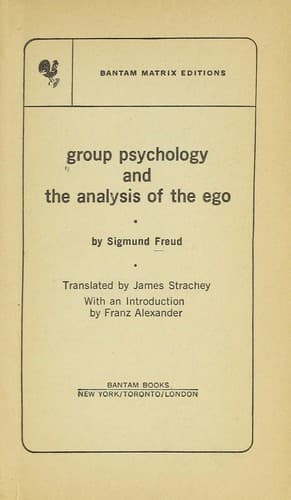
Group Psychology and The Analysis of The EgoFreud, Sigmund
Science
Group Psychology and The Analysis of The Ego
Freud, Sigmund
Ego (Psychology); Psychoanalysis; Social psychology
But these melancholias also show us something else, which may be of
importance for our later discussions. They show us the ego divided,
fallen into two pieces, one of which rages against the second. This
second piece is the one which has been altered by introjection and which
contains the lost object. But the piece which behaves so cruelly is not
unknown to us either. It comprises the conscience, a critical faculty
[_Instanz_][43] within the ego, which even in normal times takes up a
critical attitude towards the ego, though never so relentlessly and so
unjustifiably. On previous occasions we have been driven to the
hypothesis[44] that some such faculty develops in our ego which may cut
itself off from the rest of the ego and come into conflict with it. We
have called it the 'ego ideal', and by way of functions we have ascribed
to it self-observation, the moral conscience, the censorship of dreams,
and the chief influence in repression. We have said that it is the heir
to the original narcissism in which the childish ego found its
self-sufficiency; it gradually gathers up from the influences of the
environment the demands which that environment makes upon the ego and
which the ego cannot always rise to; so that a man, when he cannot be
satisfied with his ego itself, may nevertheless be able to find
satisfaction in the ego ideal which has been differentiated out of the
ego. In delusions of observation, as we have further shown, the
disintegration of this faculty has become patent, and has thus revealed
its origin in the influence of superior powers, and above all of
parents.[45] But we have not forgotten to add that the amount of
distance between this ego ideal and the real ego is very variable from
one individual to another, and that with many people this
differentiation within the ego does not go further than with children.
But before we can employ this material for understanding the libidinal
organisation of groups, we must take into account some other examples of
the mutual relations between the object and the ego.[46]
VIII
BEING IN LOVE AND HYPNOSIS
Even in its caprices the usage of language remains true to some kind of
reality. Thus it gives the name of 'love' to a great many kinds of
emotional relationship which we too group together theoretically as
love; but then again it feels a doubt whether this love is real, true,
actual love, and so hints at a whole scale of possibilities within the
range of the phenomena of love. We shall have no difficulty in making
the same discovery empirically.
Public-domain text, read in full here on John Shaqi.
Reviews
Reviews
No reviews yet
Be the first to share your thoughts on this work.
Join the Discussion
Join the discussion
Sign in to leave a comment or review.
Sign InorCreate an account