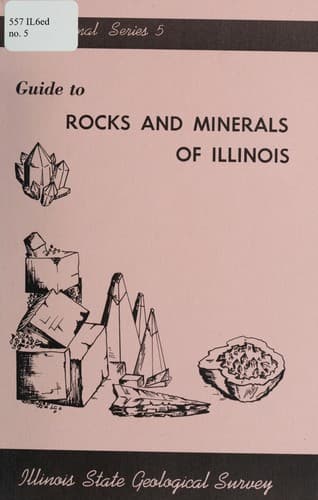
Guide to Rocks and Minerals of IllinoisIllinois State Geological Survey
Science
Guide to Rocks and Minerals of Illinois
Illinois State Geological Survey
Mineralogy -- Illinois; Petrology -- Illinois
SPHALERITE, zinc sulfide, is a major ore of zinc. It has a resinous
luster and a white, yellow, or brown streak. Illinois sphalerite is
generally yellow, yellowish brown, reddish brown, or brownish black. It
is of medium weight, brittle, can be scratched by a piece of window
glass but not by a penny. It is commonly opaque but may be translucent
on thin edges.
Sphalerite is mined with galena in northwestern Illinois and in extreme
southern Illinois with galena and fluorite. Small crystals occasionally
are found in limestones and as crystalline masses in clay-ironstone
concretions.
GALENA (31)
GALENA, lead sulfide, is the principal ore of lead. It is steel gray,
heavy, opaque, and has a bright metallic luster, though the shiny
surface may be dulled by a coating of lead carbonate. It has a gray or
black streak, is soft enough to mark paper, and can be scratched by a
penny. The cube-shaped crystals readily break into cubic, right-angled
fragments. Probably the most obvious features of the mineral are its
bright metallic luster on fresh surfaces, high specific gravity, and
cubic cleavage.
[Illustration: uncaptioned]
At many places galena is argentiferous (silver-bearing), but Illinois
galena is relatively unimportant for its silver content. As a source of
lead, however, it is an important commercial product of the state.
Scattered pieces of galena are found at many places in Illinois. Some
occur in the glacial deposits, others occur as small pockets and as
crystals in limestones and geodes. In only two areas of the state are
deposits of commercial value. In northwestern Illinois galena occurs in
association with sphalerite; in extreme southern Illinois it occurs in
association with fluorite and sphalerite.
CONCRETIONS (32)
CONCRETIONS are concentrations of inorganic sedimentary material within
other sediments. Minerals that commonly form concretions are silica (in
the form of opal, chert, chalcedony, and quartz), calcite, siderite,
pyrite, marcasite, and limonite.
Concretions may form either as the sediment around them is forming or
after the sediment around them has hardened. They may be formed when
water containing dissolved minerals seeps through the sediment or rock
and leaves a concentration of mineral matter in a cavity or around a
central particle (nucleus) such as the remains of a plant or animal.
Portions of rock may also become firmly cemented by such mineral matter.
Concretions range in size from minute particles to objects several feet
in diameter. Shapes range from spheres to tubes. Many are globular or
lumpy-surfaced, some are smooth. Because concretions generally are
harder than the surrounding rock in which they have formed, they do not
weather away as readily and may remain after the surrounding material
has been eroded.
Public-domain text, read in full here on John Shaqi.
Reviews
Reviews
No reviews yet
Be the first to share your thoughts on this work.
Join the Discussion
Join the discussion
Sign in to leave a comment or review.
Sign InorCreate an account