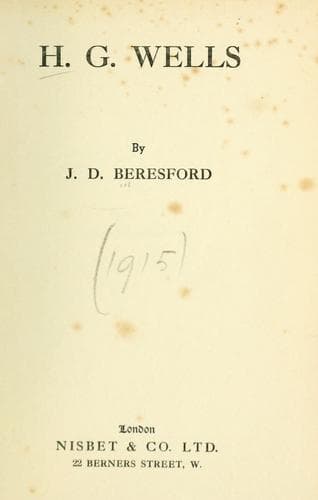
Wells, H. G. (Herbert George), 1866-1946 -- Criticism and interpretation
In the two opening chapters we find the same delightfully realistic
treatment of the unprecedented slowly mingling with the commonplace.
The first appearance of Graham the Sleeper, tormented then by the
spectres and doubts that accompany insomnia, is made so credible that
we accept his symptoms without the least demur; his condition is
merely unusual enough to excite a trembling interest. Even the
passing of his early years of trance does not arouse scepticism. But
then we fall with one terrific plunge into the world of A.D. 2100,
and, like Graham, we cannot realise it. Moreover this changed,
developed world has a slightly mechanical air. The immense enclosed
London, imagined by Mr Wells, is no Utopia, yet, like the dream of
earlier prophets, it is too logical to entice us into any
hallucination; and we come, fatally, to a criticism of the syllogism.
Mr Wells himself has confessed, in a new Preface, that this is "one of
the most ambitious and least satisfactory" of his books; and explains
that it was written against time, when he was on the verge of a
serious illness. It is superfluous, therefore, to criticise it in
detail, but one or two points in relation to the sociological idea
must be emphasised.
The main theme is the growing division between Capital and Labour.
The Giant Trust--managing the funds accumulated in Graham's name, a
trust that has obtained possession of so immense a capital that it
controls the chief activities of the world--is figured in the command
of a certain Ostrog, who, with all the dependents that profit by the
use of his wealth and such mercenaries as he can hold to himself,
represents one party in opposition to the actual workers and
producers, generically the People. The picture is the struggle of our
own day in more acute form; the result, in the amended edition, is
left open. "Who will win--Ostrog or the People?" Mr Wells writes in
the Preface referred to above, and answers: "A thousand years hence
that will still be just the open question we leave to-day."
Public-domain text, read in full here on John Shaqi.
Reviews
Reviews
No reviews yet
Be the first to share your thoughts on this work.
Join the Discussion
Join the discussion
Sign in to leave a comment or review.
Sign InorCreate an account