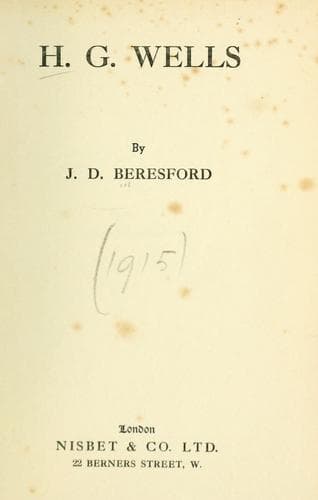
Wells, H. G. (Herbert George), 1866-1946 -- Criticism and interpretation
although it is in the mouth of one who is not presented as a spokesman
for Mr Wells' own opinions, I feel that it comes very near to being a
text for a considerable section of the political criticism; and that
it indicates bias, a departure from normality.
And yet, despite this occasional exhibition of temper, _The New
Machiavelli_ is a most illuminating book. It reveals with
extraordinary clearness the Wells of that period; but it also gives us
a sight of the spirit in him that does not change. All his books,
romances, novels and essays indicate a gradual process of growth; if
we were to apply any label to him, we should inevitably land ourselves
in confusion. He is nothing "in the first place" but a man with an
intense desire to understand life. As he says in this book: "A human
being who is a philosopher in the first place, a teacher in the first
place, or a statesman in the first place, is thereby and
inevitably--though he bring God-like gifts to the pretence--a quack."
But while he may dissociate himself from any clique, and disclaim any
fixed opinion that might earn for him the offensive and fiercely
rejected label, he nevertheless presents to us one unchanging attitude
in these very refusals. "I'm going to get experience for humanity out
of all my talents--and bury nothing," says Remington; and that purpose
is implicit in every book that Wells has written. He is an empiric,
using first this test and then that to try the phenomena of life;
publishing the detail of his experiment and noting certain
deductions. But while he may offer a prescription for certain
symptoms, he gives us to understand that he is only diagnosing a phase
in human development; that he is seeking an ultimate which he never
hopes to find, and that the deductions he draws to-day may be rejected
to-morrow without a shadow of regret. He would be constant, I think,
only in his inconstancy to any criterion of present conditions as
applicable or likely to be applicable to the future; he sees life as a
dynamic thing in process of change and growth. "All the history of
mankind," he writes, "all the history of life has been and will be the
story of something struggling out of the indiscriminated abyss,
struggling to exist and prevail over and comprehend individual
lives--an effect of insidious attraction, an idea of invincible
appeal." And it is for this reason that he is so eager to battle with,
annoy, disarrange and reconstruct that rule-of-thumb world he
censures so steadily; he is fighting the assumption of a static
condition which he knows to be impossible.
Public-domain text, read in full here on John Shaqi.
Reviews
Reviews
No reviews yet
Be the first to share your thoughts on this work.
Join the Discussion
Join the discussion
Sign in to leave a comment or review.
Sign InorCreate an account