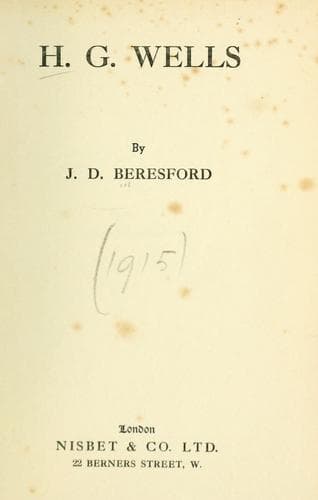
Wells, H. G. (Herbert George), 1866-1946 -- Criticism and interpretation
Such, I think, is the spirit, the permanent principle of these two
books. That remains and increases. The conception of the process by
which the New Republic shall be built is less constant, and Mr Wells
will change his opinions concerning it for just so long as he
continues to grow. Should he ever adopt an inalterable policy,
subscribe to some "ism," and wear a label, he would brand himself
truly as inconsistent. Then, indeed, he would have contradicted
himself. We search for truth never hoping to find it complete and
whole; and he who is contented with a part denies God....
_A Modern Utopia_ (1905) is an attempt to picture "The New Republic"
in being; a very different dream of reconstruction from that
displayed in Edward Bellamy's _Looking Backward_, and _Equality_, but
having nevertheless certain points of likeness to the former at least,
and especially in the method of marking contrasts by a form of
parallelism, by keeping the world as we know it within the circle of
attention in order to break the paralysing illusion that we are moving
in romantic and quite impossible surroundings. Mr Wells' machinery is
slightly complicated. He takes two figures from the beginning of this
twentieth century. The Owner of the Voice ("you will go with him
through curious and interesting experience. Yet, ever and again, you
will find him back at the table, the manuscript in his hand ...") and
the "botanist," a foil and a stimulator to the other expositor. "The
image of a cinematograph entertainment is the one to grasp," writes Mr
Wells in his preliminary explanation. "There will be an effect of
these two people going to and fro in front of the circle of a rather
defective lantern, which sometimes jams and sometimes gets out of
focus, but which does occasionally succeed in displaying on a screen a
momentary moving picture of Utopian conditions."
Public-domain text, read in full here on John Shaqi.
Reviews
Reviews
No reviews yet
Be the first to share your thoughts on this work.
Join the Discussion
Join the discussion
Sign in to leave a comment or review.
Sign InorCreate an account