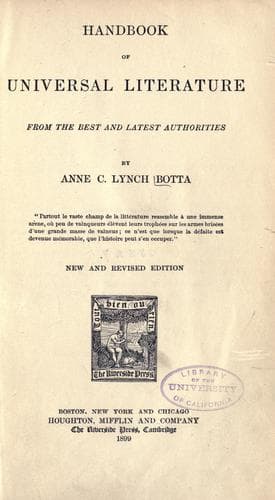
Handbook of Universal Literature, From the Best and Latest AuthoritiesBotta, Anne C. Lynch (Anne Charlotte Lynch)
History
Handbook of Universal Literature, From the Best and Latest Authorities
Botta, Anne C. Lynch (Anne Charlotte Lynch)
Literature -- History and criticism
The fundamental principle of Plato's philosophy is the belief in an
eternal and self-existent cause, the origin of all things. From this
divine Being emanate not only the souls of men, which are immortal, but
that of the universe itself, which is supposed to be animated by a divine
spirit. The material objects of our sight, and other senses, are mere
fleeting emanations of the divine idea; it is only this idea itself that
is really existent; the objects of sensuous perception are mere
appearances, taking their forms by participation in the idea; hence it
follows, that in Plato's philosophy all knowledge is innate, and acquired
by the soul before birth, when it was able to contemplate real existences,
and all our ideas of this world are mere reminiscences of their true and
eternal patterns. The belief of Plato in the immortality of the soul
naturally led him to establish a high standard of moral excellence, and,
like his great teacher, he constantly inculcates temperance, justice, and
purity of life. His political views are developed in the "Republic" and in
the "Laws," in which the main feature of his system is the subordination,
or rather the entire sacrifice of the individual to the state.
The style of Plato is in every way worthy of his position in universal
literature, and modern scholars have confirmed the encomium of Aristotle,
that all his dialogues exhibit extraordinary acuteness, elaborate
elegance, bold originality, and curious speculation. In Plato, the powers
of imagination were just as conspicuous as those of reasoning and
reflection; he had all the chief characteristics of a poet, especially of
a dramatic poet, and if his rank as a philosopher had been lower than it
is, he would still have ranked high among dramatic writers for his life-
like representations of the personages whose opinions he wished to combat
or to defend.
Aristotle (384-322 B.C.) occupies a position among the leaders of human
thought not inferior to that of his teacher, Plato. He was a native of
Stagyra, in Macedonia, and is hence often called the Stagyrite. He early
repaired to Athens, and became a pupil of Plato, who called him the soul
of his school. He was afterwards invited by Philip of Macedon to undertake
the literary education of Alexander, at that time thirteen years old. This
charge continued about three years. He afterwards returned to Athens,
where he opened his school in a gymnasium called the Lyceum, delivering
his lessons as he walked to and fro, and from these saunters his scholars
were called Peripatetics, or saunterers. During this period he composed
most of his extant works. Alexander placed at his disposal a large sum for
his collections in natural history, and employed some thousands of men in
procuring specimens for his museum. After the death of Alexander, he was
accused of blasphemy to the gods, and, warned by the fate of Socrates, he
withdrew from Athens to Chalcis, where he afterwards died.
Public-domain text, read in full here on John Shaqi.
Reviews
Reviews
No reviews yet
Be the first to share your thoughts on this work.
Elsewhere in the archive
Join the Discussion
Join the discussion
Sign in to leave a comment or review.
Sign InorCreate an account