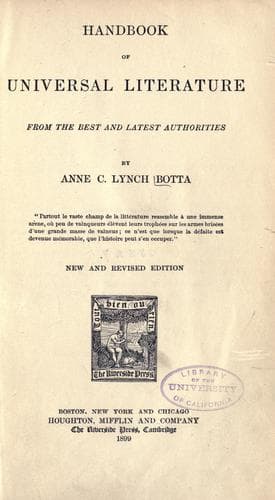
Handbook of Universal Literature, From the Best and Latest AuthoritiesBotta, Anne C. Lynch (Anne Charlotte Lynch)
History
Handbook of Universal Literature, From the Best and Latest Authorities
Botta, Anne C. Lynch (Anne Charlotte Lynch)
Literature -- History and criticism
In looking at the mere catalogue of the works of Aristotle, we are struck
with his vast range of knowledge. He aimed at nothing less than the
completion of a general encyclopedia of philosophy. He was the author of
the first scientific cultivation of each science, and there was hardly any
quality distinguishing a philosopher as such, which he did not possess in
an eminent degree. Of all the philosophical systems of antiquity, that of
Aristotle was the best adapted to the physical wants of mankind. His works
consisted of treatises on natural, moral, and political philosophy,
history, rhetoric, criticism,--indeed, there was scarcely a branch of
knowledge which his vast and comprehensive genius did not embrace. His
greatest claim to our admiration is as a logician. He perfected and
brought into form those elements of the dialectic art which had been
struck out by Socrates and Plato, and wrought them, by his additions, into
so complete a system, that he may be regarded as, at once, the founder and
perfecter of logic as an art, which has since, even down to our own days,
been but very little improved. The style of Aristotle has nothing to
attract those who prefer the embellishments of a work to its subject-
matter and the scientific results which it presents.
PERIOD THIRD.
EPOCH OF THE DECLINE OF GREEK LITERATURE, 322 B.C.-1453 A.D.
1. ORIGIN OF THE ALEXANDRIAN LITERATURE.--As the literary predominance of
Athens was due mainly to the political importance of Attica, the downfall
of Athenian independence brought with it a deterioration, and ultimately
an extinction of that intellectual centralization which for more than a
century had fostered and developed the highest efforts of the genius and
culture of the Greeks. While the living literature of Greece was thus
dying away, the conquests of Alexander prepared a new home for the muses
on the coast of that wonderful country, to which all the nations of
antiquity had owed a part of their science and religious belief. In Egypt,
as in other regions, Alexander gave directions for the foundation of a
city to be called after his own name, which became the magnificent
metropolis of the Hellenic world. This capital was the residence of a
family who attracted to their court all the living representatives of the
literature of Greece, and stored up in their enormous library all the best
works of the classical period. It was chiefly during the reigns of the
first three Ptolemies that Alexandria was made the new home of Greek
literature. Ptolemy Soter (306-285 B.C.) laid the foundations of the
library, and instituted the museum, or temple of the muses, where the
literary men of the age were maintained by endowments. This encouragement
of literature was continued by Ptolemy Philadelphus (285-247 B.C.). He had
the celebrated Callimachus for his librarian, who bought up not only the
whole of Aristotle's great collection of works, but transferred the native
Public-domain text, read in full here on John Shaqi.
Reviews
Reviews
No reviews yet
Be the first to share your thoughts on this work.
Elsewhere in the archive
Join the Discussion
Join the discussion
Sign in to leave a comment or review.
Sign InorCreate an account