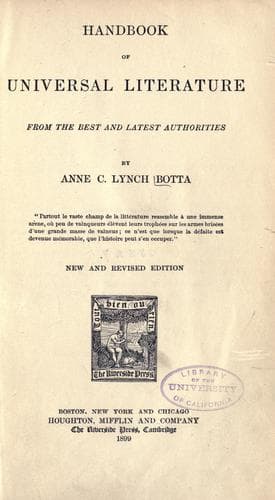
Handbook of Universal Literature, From the Best and Latest AuthoritiesBotta, Anne C. Lynch (Anne Charlotte Lynch)
History
Handbook of Universal Literature, From the Best and Latest Authorities
Botta, Anne C. Lynch (Anne Charlotte Lynch)
Literature -- History and criticism
annals of Egypt and Judea to the domain of Greek literature by employing
the priest Manetho to translate the hieroglyphics of his own temple-
archives into the language of the court, and by procuring from the
Sanhedrim of Jerusalem the first part of that celebrated version of the
Hebrew sacred books, which was afterwards completed and known as the
Septuagint, or version of the Seventy. Ptolemy Euergetes (247-222 B.C.)
increased the library by depriving the Athenians of their authentic
editions of the great dramatists. In the course of time the library
founded at Pergamos was transferred to Egypt, and thus we are indebted to
the Ptolemies for preserving to our times all the best specimens of Greek
literature which have come down to us. This encouragement of letters,
however, called forth no great original genius; but a few eminent men of
science, many second-rate and artificial poets, and a host of grammarians
and literary pedants.
2. THE ALEXANDRIAN POETS.--Among the poets of the period, Philetas,
Callimachus, Lycophron, Apollonius, and the writers of idyls, Theocritus,
Bion, and Moschus are the most eminent. The founder of a school of poetry
at Alexandria, and the model for imitation with the Roman writers of
elegiac poetry, was Philetas of Cos (fl. 260 B. C), whose extreme
emaciation of person exposed him to the imputation of wearing lead in the
soles of his shoes, lest he should be blown away. He was chiefly
celebrated as an elegiac poet, in whom ingenious, elegant, and harmonious
versification took the place of higher poetry. Callimachus (fl. 260 B.C.)
was the type of an Alexandrian man of letters, distinguished by skill
rather than genius, the most finished specimen of what might be effected
by talent, learning, and ambition, backed by the patronage of a court. He
was a living representative of the great library over which he presided;
he was not only a writer of all kinds of poetry, but a critic, grammarian,
historian, and geographer. Of his writings, a few poems only are extant.
Next to Callimachus, as a representative of the learned poetry of
Alexandria, stands the dramatist Lycophron (fl. 250 B.C.). All his works
are lost, with the exception of the oracular poem called the "Alexandra,"
or "'Cassandra," on the merits of which very opposite opinions are
entertained. Apollonius, known as the Rhodian (fl. 240 B.C.), was a native
of Alexandria, and a pupil of Callimachus, through whose influence he was
driven from his native city, when he established himself in the island of
Rhodes, where he was so honored and distinguished that he took the name of
the Rhodian. On the death of Callimachus, he was appointed to succeed him
as librarian at Alexandria. His reputation depends on his epic poem, the
"Argonautic Expedition."
Public-domain text, read in full here on John Shaqi.
Reviews
Reviews
No reviews yet
Be the first to share your thoughts on this work.
Elsewhere in the archive
Join the Discussion
Join the discussion
Sign in to leave a comment or review.
Sign InorCreate an account