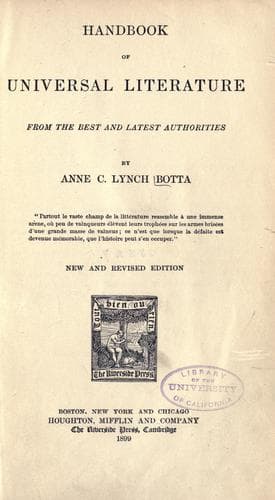
Handbook of Universal Literature, From the Best and Latest AuthoritiesBotta, Anne C. Lynch (Anne Charlotte Lynch)
History
Handbook of Universal Literature, From the Best and Latest Authorities
Botta, Anne C. Lynch (Anne Charlotte Lynch)
Literature -- History and criticism
Of all the writers of the Alexandrian period, the bucolic poets have
enjoyed the most popularity. Their pastoral poems were called Idyls, from
their pictorial and descriptive character, that is, little pictures of
common life, a name for which the later writers have sometimes substituted
the term Eclogues, that is, _selections_, which is applicable to any short
poem, whether complete and original, or appearing as an extract. The name
of Idyls, however, was afterwards applicable to pastoral poems. Theocritus
(fl. 272 B.C.) gives his name to the most important of these extant
bucolics. He had an original genius for poetry of the highest kind; the
absence of the usual affectation of the Alexandrian school, constant
appeals to nature, a fine perception of character, and a keen sense of
both the beautiful and the ludicrous, indicate the high order of his
literary talent, and account for his universal and undiminished
popularity. The two other bucolic poets of the Alexandrian school were
Bion (fl. 275 B.C.), born near Smyrna, and his pupil Moschus of Syracuse
(fl. 273 B.C.). It appears, from an elegy by Moschus, that Bion migrated
from Asia Minor to Sicily, where he was poisoned. He wrote harmonious
verses with a good deal of pathos and tenderness, but he is as inferior to
Theocritus as he is superior to Moschus, whose artificial style
characterizes him rather as a learned versifier than a true poet.
3. PROSE WRITERS OF ALEXANDRIA.--Many of the most eminent poets were also
prose writers, and they exhibited their versatility by writing on almost
every subject of literary interest. The progress of prose writing
manifested itself from grammar and criticism to the more elaborate and
learned treatment of history and chronology, and to observations and
speculations in pure and mixed mathematics. Demetrius the Phalerian (fl.
295 B.C.), Zenodotus (fl. 279 B.C.), Aristophanes (fl. 200 B.C.), and
Aristarchus (fl. 156 B.C.), the three last of whom were successively
intrusted with the management of the Library, were the representatives of
the Alexandrian school of grammar and criticism. They devoted themselves
chiefly to the revision of the text of Homer, which was finally
established by Aristarchus.
Public-domain text, read in full here on John Shaqi.
Reviews
Reviews
No reviews yet
Be the first to share your thoughts on this work.
Elsewhere in the archive
Join the Discussion
Join the discussion
Sign in to leave a comment or review.
Sign InorCreate an account