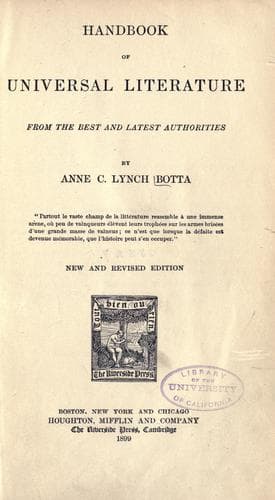
Handbook of Universal Literature, From the Best and Latest AuthoritiesBotta, Anne C. Lynch (Anne Charlotte Lynch)
History
Handbook of Universal Literature, From the Best and Latest Authorities
Botta, Anne C. Lynch (Anne Charlotte Lynch)
Literature -- History and criticism
Among the scientific men of this period we find Ptolemy, whose name for
more than a thousand years was coextensive with the sciences of astronomy
and geography. He was a native of Alexandria, and flourished about the
latter part of the second century. The best known of his works is his
"Great Construction of Astronomy." He was the first to indicate the true
shape of Spain, Gaul, and Ireland; as a writer, he deserves to be held in
high estimation. Galen (fl. 130 A.D.) was a writer on philosophy and
medicine, with whom few could vie in productiveness. It was his object to
combine philosophy with medical science, and his works for fifteen
centuries were received as oracular authorities throughout the civilized
world.
7. CONTINUED DECLINE OF GREEK LITERATURE.--The adoption of the Christian
religion by Constantine, and his establishment of the seat of government
in his new city of Constantinople, concurred in causing the rapid decline
of Greek literature in the fourth and following centuries. Christianity,
no longer the object of persecution, became the dominant religion of the
state, and the profession of its tenets was the shortest road to influence
and honor. The old literature, with its mythological allusions, became
less and less fashionable, and the Greek poets, philosophers, and orators
of the better periods gradually lost their attractions. Greek, the
official language of Constantinople, was spoken there, with different
degrees of corruption, by Syrians, Bulgarians, and Goths; and thus, as
Christianity undermined the old classical literature, the political
condition of the capital deteriorated the language itself. Other causes
accelerated the decadence of Greek learning: the great library at
Alexandria, and the school which had been established in connection with
it, were destroyed at the end of the fourth century by the edict of
Theodosius, and the conquest of Egypt by the Saracens in the seventh
century only completed the work of destruction. Justinian closed the
schools of Athens, and prohibited the teaching of philosophy; the Arabs
overthrew those established elsewhere, and there remained only the
institutions of Constantinople. But long before the establishment of the
Turks on the ruins of the Byzantine empire, Greek literature had ceased to
claim any original or independent existence. The opposition between the
literary spirit of heathen Greece and the Christian scholarship of the
time of Constantine and his immediate successors, which grew up very
gradually, was the result of the Oriental superstitions which distorted
Christianity and disturbed the old philosophy. The abortive attempt of the
Emperor Julian to create a reaction in favor of heathenism was the cause
of the open antagonism between the classical and Christian forms of
literature. The church, however, was soon enabled not only to dictate its
own rules of literary criticism, but to destroy the writings of its most
formidable antagonists.
Public-domain text, read in full here on John Shaqi.
Reviews
Reviews
No reviews yet
Be the first to share your thoughts on this work.
Elsewhere in the archive
Join the Discussion
Join the discussion
Sign in to leave a comment or review.
Sign InorCreate an account