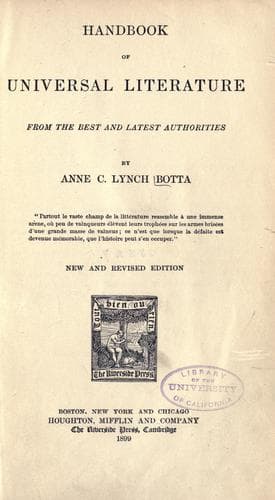
Handbook of Universal Literature, From the Best and Latest AuthoritiesBotta, Anne C. Lynch (Anne Charlotte Lynch)
History
Handbook of Universal Literature, From the Best and Latest Authorities
Botta, Anne C. Lynch (Anne Charlotte Lynch)
Literature -- History and criticism
The last rays of heathen cultivation in Italy were
extinguished in the gloomy dungeon of Boethius, and the period so justly
designated as the Dark Ages began both in eastern and western Europe.
8. LAST ECHOES OF THE OLD LITERATURE--From the time when Christianity
placed itself in opposition to the old culture of heathen Greece and Rome,
down to the period of the revival of classical literature in the fifteenth
and sixteenth centuries, the classical spirit was nearly extinct both in
eastern and western Europe. In Italy, the triumph of barbarism was more
sudden and complete. In the eastern empire there was a certain literary
activity, and in the department of history, Byzantine literature was
conspicuously prolific.
The imperial family of the Comneni, in the eleventh and twelfth centuries,
and the Palaeologi, who reigned from the thirteenth century to the end of
the eastern empire, endeavored to revive the taste for literature and
learning. But the echoes of the past became fainter and fainter, and when
Constantinople fell into the hands of the Turks, 1453 A.D., the wandering
Greeks who found their way into Italy could only serve as language-masters
to a race of scholars, who thus recovered the learning that had ceased to
exist among the Greeks themselves.
The last manifestations of the old classical learning by the Alexandrian
school, which had done so much in the second and first centuries before
our era, may he divided into three classes. In the first are placed the
mathematical and geographical studies, which had been brought to such
perfection by Euclid, his successors, and after them by Ptolemy. In the
second class we have the substitution of prose romances for the bucolic
and erotic poetry of the Alexandrian and Sicilian writers. In the third
class the revival, by Nonnus and his followers, of a learned epos, of much
the same kind as the poems of Callimachus. Among the representatives of
the mathematical school of Alexandria was Theon, whose celebrity is
obscured by that of his daughter Hypatia (fl. 415 A.D.), whose sex, youth,
beauty, and cruel fate have made her a most interesting martyr of
philosophy. She presided in the public school at Alexandria, where she
taught mathematics and the philosophy of Ammonius and Plotinus. Her
influence over the educated classes of that city excited the jealousy of
the archbishop. She was given up to the violence of a superstitious and
brutal mob, attacked as she was passing through the streets in her
chariot, torn in pieces, and her mutilated body thrown to the flames.
Public-domain text, read in full here on John Shaqi.
Reviews
Reviews
No reviews yet
Be the first to share your thoughts on this work.
Elsewhere in the archive
Join the Discussion
Join the discussion
Sign in to leave a comment or review.
Sign InorCreate an account