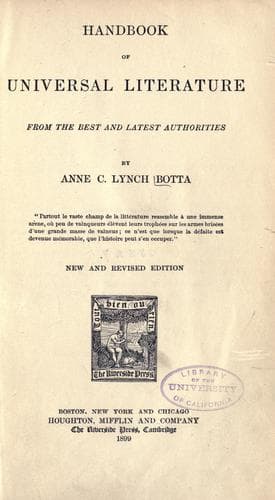
Handbook of Universal Literature, From the Best and Latest AuthoritiesBotta, Anne C. Lynch (Anne Charlotte Lynch)
History
Handbook of Universal Literature, From the Best and Latest Authorities
Botta, Anne C. Lynch (Anne Charlotte Lynch)
Literature -- History and criticism
When rhetorical prose superseded composition in verse, the greater
facility of style naturally led to more detailed narratives, and the
sophist who would have been a poet in the time of Callimachus, became a
writer of prose romances in the final period of Greek literature. The
first ascertained beginning of this style of light reading, which occupies
so large a space in the catalogues of modern libraries, was in the time of
the Emperor Trajan, when a Syrian or Babylonian freedman, named
Iamblichus, published a love story called the "Babylonian Adventures."
Among his successors is Longus, of whose work, "The Lesbian Adventure," it
is sufficient to say, that it was the model of the "Diana" of Montemayor,
the "Aminta" of Tasso, the "Pastor Fido" of Guarini, and the "Gentle
Shepherd" of Allan Ramsay.
While the sophists were amusing themselves by clothing erotic and bucolic
subjects in rhetorical prose, an Egyptian boldly revived the epos which
had been cultivated at Alexandria in the earliest days of the Museum.
Nonnus probably flourished at the commencement of the fifth century A.D.
His epic poem, which, in accordance with the terminology of the age, is
called "Dionysian Adventures," is an enormous farrago of learning on the
well-worked subject of Bacchus. The most interesting of the epic
productions of the school of Nonnus is the story of "Hero and Leander," in
340 verses, which bears the name of Musaeus. For grace of diction,
metrical elegance, and simple pathos, this little canto stands far before
the other poems of the same age. The Hero and Leander of Musaeus is the
dying swan-note of Greek poetry, the last distinct note of the old music
of Hellas.
In the Byzantine literature, there are works which claim no originality,
but have a higher value than their contemporaries, because they give
extracts or fragments of the lost writings of the best days of Greece.
Next in value follow the lexicographers, the grammarians, and
commentators. The most voluminous department, however, of Byzantine
literature, was that of the historians, annalists, chroniclers,
biographers, and antiquarians, whose works form a continuous series of
Byzantine annals from the time of Constantine the Great to the taking of
the capital by the Turks. This literature was also enlivened by several
poets, and enriched by some writers on natural history and medicine.
Public-domain text, read in full here on John Shaqi.
Reviews
Reviews
No reviews yet
Be the first to share your thoughts on this work.
Elsewhere in the archive
Join the Discussion
Join the discussion
Sign in to leave a comment or review.
Sign InorCreate an account