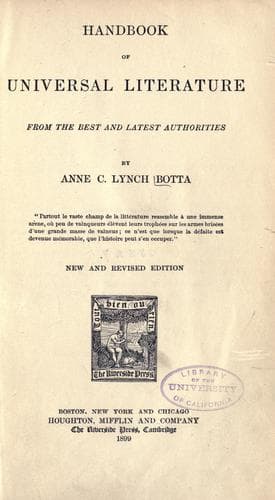
Handbook of Universal Literature, From the Best and Latest AuthoritiesBotta, Anne C. Lynch (Anne Charlotte Lynch)
History
Handbook of Universal Literature, From the Best and Latest Authorities
Botta, Anne C. Lynch (Anne Charlotte Lynch)
Literature -- History and criticism
9. THE NEW TESTAMENT AND THE GREEK FATHERS.--The history of Greek
literature would be imperfect without some allusion to a class of writings
not usually included in the range of classical studies. The first of these
works, the Septuagint version of the Old Testament, before mentioned, and
the Greek Apocrypha, may properly be termed Hebrew-Grecian. Their spirit
is wholly at variance with that of pagan literature, and it cannot be
doubted that they exerted great influence when made known to the pagans of
Alexandria. Many of the books termed the Apocrypha were originally written
in Greek, and mostly before the Christian era. Many of them contain
authentic narratives, and are valuable as illustrating the circumstances
of the age to which they refer. The other class of writings alluded to
comprehends the works of the Christian authors. As the influence of
Christianity became more diffused during the first and second centuries,
its regenerating power became visible. After the time of Christ, there
appeared, in both the Greek and Latin tongues, works wholly different in
their spirit and character from all that is found in pagan literature. The
collection of sacred writings contained in the New Testament and the works
of the early fathers constitute a distinct and interesting feature in the
literature of the age in which they appeared. The writings of the New
Testament, considered simply in their literary aspect, are distinguished
by a simplicity, earnestness, naturalness, and beauty that find no
parallel in the literature of the world. But the consideration must not be
overlooked, that they were the work of those men who wrote as they were
moved of the Holy Ghost, that they contain the life and the teachings of
the great Founder of our faith, and that they come to us invested with
divine authority. Their influence upon the ages which have succeeded them
is incalculable, and it is still widening as the knowledge of Christianity
increases. The composition of the New Testament is historical, epistolary,
and prophetic. The first five books, or the historical division, contain
an account of the life and death of our Saviour, and some account of the
first movements of the Apostles. The epistolary division consists of
letters addressed by the Apostles to the different churches or to
individuals. The last, the book of Revelation, the only part that is
considered prophetic, differs from the others in its use of that
symbolical language which had been common to the Hebrew prophets, in the
sublimity and majesty of its imagery, and in its prediction of the final
and universal triumph of Christianity.
Public-domain text, read in full here on John Shaqi.
Reviews
Reviews
No reviews yet
Be the first to share your thoughts on this work.
Elsewhere in the archive
Join the Discussion
Join the discussion
Sign in to leave a comment or review.
Sign InorCreate an account