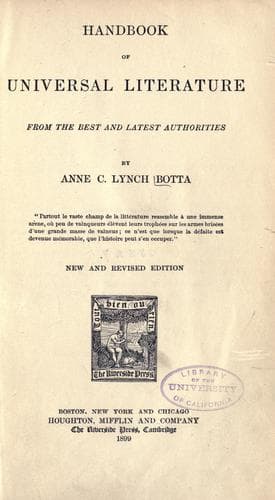
Handbook of Universal Literature, From the Best and Latest AuthoritiesBotta, Anne C. Lynch (Anne Charlotte Lynch)
History
Handbook of Universal Literature, From the Best and Latest Authorities
Botta, Anne C. Lynch (Anne Charlotte Lynch)
Literature -- History and criticism
A wide gap separates this old Latin from the Latin of Ennius, whose style
was formed by Greek taste; another not so wide is interposed between the
age of Ennius and that of Plautus and Terence, and lastly, Cicero and the
Augustan poets mark another age. But in all its periods of development,
the Latin bears a most intimate relation with the Greek. This similarity
is the result both of their common origin from the primitive Pelasgian and
of the intercourse which the Romans at a later period held with the
Greeks. Latin, however, had not the plastic property of the Greek, the
faculty of transforming itself into every variety of form and shape
conceived by the fancy and imagination; it partook of the spirit of Roman
nationality, of the conscious dignity of the Roman citizen, of the
indomitable will that led that people to the conquest of the world. In its
construction, instead of conforming to the thought, it bends the thought
to its own genius. It is a fit language for expressing the thoughts of an
active and practical, but not of an imaginative and speculative people. It
was propagated, like the dominion of Rome, by conquest. It either took the
place of the language of the conquered nation, or became ingrafted upon
it, and gradually pervaded its composition; hence its presence is
discernible in all European languages.
3. THE RELIGION.--The religion and mythology of Etruria left an indelible
stamp on the rites and ceremonies of the Roman people. At first they
worshiped heaven and earth, personified in Saturn and Ops, by whom Juno,
Vesta, and Ceres were generated, symbolizing marriage, family, and
fertility; soon after, other Etruscan divinities were introduced, such as
Jupiter, Minerva, and Janus; and Sylvanus and Faunus, who delighted in the
simple occupations of rural and pastoral life. From the Etrurians the
Romans borrowed, also, the institution of the Vestals, whose duty was to
watch and keep alive the sacred fire of Vesta; the Lares and Penates, the
domestic gods, which presided over the dwelling and family; Terminus, the
god of property and the rites connected with possession; and the orders of
Augurs and Aruspices, whose office was to consult the flight of birds or
to inspect the entrails of animals offered in sacrifice, in order to
ascertain future events. The family of the Roman gods continued to
increase by adopting the divinities of the conquered nations, and more
particularly by the introduction of those of Greece. The general division
of the gods was twofold,--the superior and inferior deities. The first
class contained the Consentes and the Selecti; the second, the Indigetes
and Semones. The Consentes, so called because they were supposed to form
the great council of heaven, consisted of twelve: Jupiter, Neptune,
Apollo, Mars, Mercury, Vulcan, Juno, Minerva, Ceres, Diana, Venus, and
Vesta. The Selecti were nearly equal to them in rank, and consisted of
eight: Saturn, Pluto, Bacchus, Janus, Sol, Genius, Rhea, and Luna. The
Public-domain text, read in full here on John Shaqi.
Reviews
Reviews
No reviews yet
Be the first to share your thoughts on this work.
Elsewhere in the archive
Join the Discussion
Join the discussion
Sign in to leave a comment or review.
Sign InorCreate an account