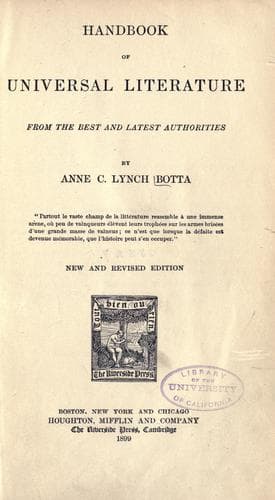
Handbook of Universal Literature, From the Best and Latest AuthoritiesBotta, Anne C. Lynch (Anne Charlotte Lynch)
History
Handbook of Universal Literature, From the Best and Latest Authorities
Botta, Anne C. Lynch (Anne Charlotte Lynch)
Literature -- History and criticism
Indigites were heroes who were ranked among the gods, and included
particularly Hercules, Castor and Pollux, and Quirinus or Romulus. The
Semones comprehended those deities that presided over particular objects,
as Pan, the god of shepherds; Flora, the goddess of flowers, etc. Besides
these, there were among the inferior gods a numerous class of deities,
including the virtues and vices and other objects personified.
The religion of the Romans was essentially political, and employed as a
means of promoting the designs of the state. It was prosaic in its
character, and in this respect differed essentially from the artistic and
poetical religion of the Greeks. The Greeks conceived religion as a free
and joyous worship of nature, a centre of individuality, beauty, and
grace, as well as a source of poetry, art, and independence. With the
Romans, on the contrary, religion conveyed a mysterious and hidden idea,
which gave to this sentiment a gloomy and unattractive character, without
either moral or artistic influence.
PERIOD FIRST.
FROM THE CONCLUSION OF THE FIRST PUNIC WAR TO THE AGE OF CICERO
(241-74 B.C.)
1. EARLY LITERATURE OF THE ROMANS.--The Romans, like all other nations,
had oral poetical compositions before they possessed any written
literature. Cicero speaks of the banquet being enlivened by the songs of
bards, in which the exploits of heroes were recited and celebrated. By
these lays national pride and family vanity were gratified, and the
anecdotes, thus preserved, furnished sources of early legendary history.
But these legends must not be compared to those of Greece, in which the
religious sentiment gave a supernatural glory to the effusions of the
bard, painted men as heroes and heroes as deities, and, while it was the
natural growth of the Greek intellect, twined itself around the affections
of the people. The Roman religion was a ceremonial for the priests, and
not for the people, and in Roman tradition there are no traces of elevated
genius or poetical inspiration. The Romans possessed the germs of those
faculties which admit of cultivation and improvement, such as taste and
genius, and the appreciation of the beautiful; but they did not possess
those natural gifts of fancy and imagination which formed part of the
Greek mind, and which made that nation in a state of infancy, almost of
barbarism, a poetical people. With them literature was not of spontaneous
growth; it was chiefly the result of the influence exerted by the
Etruscans, who were their teachers in everything mental and spiritual.
Public-domain text, read in full here on John Shaqi.
Reviews
Reviews
No reviews yet
Be the first to share your thoughts on this work.
Elsewhere in the archive
Join the Discussion
Join the discussion
Sign in to leave a comment or review.
Sign InorCreate an account