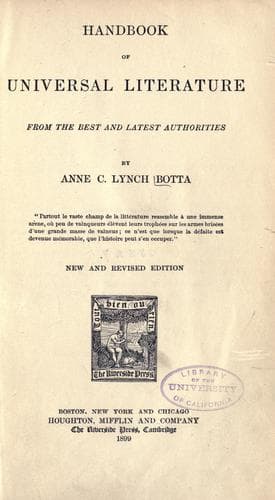
Handbook of Universal Literature, From the Best and Latest AuthoritiesBotta, Anne C. Lynch (Anne Charlotte Lynch)
History
Handbook of Universal Literature, From the Best and Latest Authorities
Botta, Anne C. Lynch (Anne Charlotte Lynch)
Literature -- History and criticism
The tendency of the Roman mind was essentially utilitarian. Even Cicero,
with all his varied accomplishments, will recognize but one end and object
of all study, namely, those sciences which will render man useful to his
country, and the law of literary development is modified according to this
ruling principle. From the very beginning, the first cause of Roman
literature will be found to have been a view to utility and not to the
satisfaction of an impulsive feeling.
In other nations, poetry has been the first spontaneous production. With
the Romans, the first written literary effort was history; but even their
early history was a simple record of facts, not of ideas or sentiments,
and valuable only for its truth and accuracy. Their original documents,
mere records of memorable events anterior to the capture of Rome by the
Gauls, perished in the conflagration of the city.
The earliest attempt at versification made by the rude inhabitants of
Latium was satire in a somewhat dramatic form. The Fescennine songs were
metrical, for the accompaniments of music and dancing necessarily
restricted them to measure, and, like the dramatic exhibitions of the
Greeks, they had their origin among the rural population, not like them in
any religious ceremonial, but in the pastimes of the village festival. At
first they were innocent and gay, but liberty at length degenerated into
license, and gave birth to malicious and libelous attacks upon persons of
irreproachable character. This infancy of song illustrates the character
of the Romans in its rudest and coarsest form. They loved strife, both
bodily and mental, and they thus early displayed that taste which, in more
polished ages, and in the hands of cultivated poets, was developed in the
sharp, cutting wit, and the lively but piercing points of Roman satire.
Public-domain text, read in full here on John Shaqi.
Reviews
Reviews
No reviews yet
Be the first to share your thoughts on this work.
Elsewhere in the archive
Join the Discussion
Join the discussion
Sign in to leave a comment or review.
Sign InorCreate an account