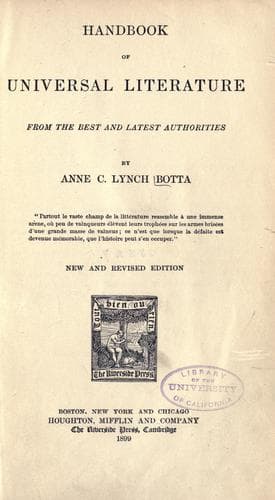
Handbook of Universal Literature, From the Best and Latest AuthoritiesBotta, Anne C. Lynch (Anne Charlotte Lynch)
History
Handbook of Universal Literature, From the Best and Latest Authorities
Botta, Anne C. Lynch (Anne Charlotte Lynch)
Literature -- History and criticism
In the Fescennine songs the Etruscans probably furnished the spectacle,
all that which addresses itself to the eye, while the habits of Italian
rural life supplied the sarcastic humor and ready extemporaneous gibe,
which are the essence of the true comic. The next advance in point of art
must be attributed to the Oscans, whose entertainments were most popular
among the Italian nations. They represented in broad caricature national
peculiarities. Their language was, originally, Oscan, as well as the
characters represented. The principal one resembled the clown of modern
pantomime; another was a kind of pantaloon or charlatan, and much of the
rest consisted of practical jokes, like that of the Italian Polincinella.
After their introduction at Rome, they received many improvements; they
lost their native rusticity; their satire was good-natured; their jests
were seemly, and kept in check by the laws of good taste. They were not
acted by common professional performers, and even a Roman citizen might
take part in them without disgrace. They were known by the name of
"Fabulae Atellanae," from Attela, a town in Campania, where they were
first performed. They remained in favor with the Roman people for
centuries. Sylla amused his leisure hours in writing them, and Suetonius
bears testimony to their having been a popular amusement under the empire.
Towards the close of the fourth century, the Etruscan _histriones_ were
introduced, whose entertainments consisted of graceful national dances,
accompanied with the music of the flute, but without either songs or
dramatic action. With these dances the Romans combined the old Fescennine
songs, and the varied metres, which their verse permitted to the vocal
parts, gave to this mixed entertainment the name of Satura (a hodge-podge
or potpourri), from which, in after times, the word satire was derived.
Public-domain text, read in full here on John Shaqi.
Reviews
Reviews
No reviews yet
Be the first to share your thoughts on this work.
Elsewhere in the archive
Join the Discussion
Join the discussion
Sign in to leave a comment or review.
Sign InorCreate an account