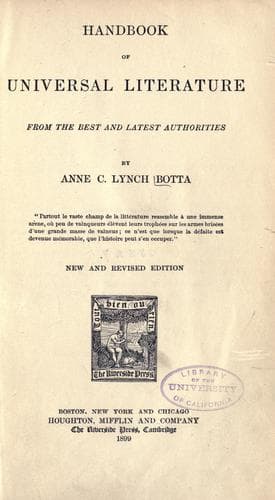
Handbook of Universal Literature, From the Best and Latest AuthoritiesBotta, Anne C. Lynch (Anne Charlotte Lynch)
History
Handbook of Universal Literature, From the Best and Latest Authorities
Botta, Anne C. Lynch (Anne Charlotte Lynch)
Literature -- History and criticism
L. Licinius Crassus was four years younger than Antonius, and acquired
great reputation for his knowledge of jurisprudence, for his eminence as a
pleader, and, above all, for his powerful and triumphant orations in
support of the restoration of the judicial office to the senators. From
among the crowd of orators, who were then flourishing in the last days of
expiring Roman liberty, Cicero selected Crassus to be the representative
of his sentiments in his imaginary conversation in "The Orator." Like Lord
Chatham, Crassus almost died on the floor of the Senate house, and his
last effort was in support of the aristocratic party.
Q. Hortensius was born 114 B.C. He was only eight years senior to the
greatest of all Roman orators. He early commenced his career as a pleader,
and he was the acknowledged leader of the Roman bar, until the star of
Cicero arose. His political connection with the faction of Sylla, and his
unscrupulous support of the profligate corruption which characterized that
administration, both at home and abroad, enlisted his legal talents in
defense of the infamous Verres; but the eloquence of Cicero, together with
the justice of the cause which he espoused, prevailed; and from that time
forward his superiority over Hortensius was established and complete. The
style of Hortensius was Asiatic--more florid and ornate than polished and
refined.
9. ROMAN JURISPRUDENCE.--The framework of their jurisprudence the Romans
derived from Athens, but the complete structure was built up by their own
hands. They were the authors of a system possessing such stability that
they bequeathed it, as an inheritance, to modern Europe, and traces of
Roman law are visible in the legal systems of the whole civilized world.
The complicated principles of jurisprudence of the Roman constitution
became, in Rome, a necessary part of a liberal education. When a Roman
youth had completed his studies, under his teacher of rhetoric, he not
only frequented the forum, in order to learn the application of the
rhetorical principles he had acquired, and frequently took some celebrated
orator as a model, but also studied the principles of jurisprudence under
eminent jurists, and attended the consultations in which they gave to
their clients their expositions of law.
Public-domain text, read in full here on John Shaqi.
Reviews
Reviews
No reviews yet
Be the first to share your thoughts on this work.
Elsewhere in the archive
Join the Discussion
Join the discussion
Sign in to leave a comment or review.
Sign InorCreate an account