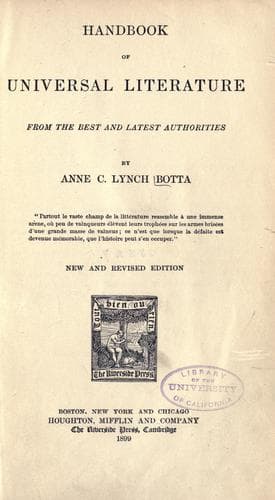
Handbook of Universal Literature, From the Best and Latest AuthoritiesBotta, Anne C. Lynch (Anne Charlotte Lynch)
History
Handbook of Universal Literature, From the Best and Latest Authorities
Botta, Anne C. Lynch (Anne Charlotte Lynch)
Literature -- History and criticism
The earliest systematic works on Roman law were the "Manual" of Pomponius,
and the "Institutes" of Gaius, who flourished in the time of Hadrian and
the Antonines. Both of these works were, for a long time, lost, though
fragments were preserved in the pandects of Justinian. In 1816, however,
Niebuhr discovered a palimpsest MS., in which the epistles of St. Jerome
were written over the erased "Institutes" of Gaius. From the numerous
misunderstandings of the Roman historians respecting the laws and
constitutional history of their country, the subject continued long in a
state of confusion, until Vico, in his "Scienza nuova," dispelled the
clouds of error, and reduced it to a system; and he was followed so
successfully by Niebuhr, that modern students can have a more
comprehensive and antiquarian knowledge of the subject than the writers of
the Augustan age.
The earliest Roman laws were the "Leges Regiae," which were collected and
codified by Sextus Papirius, and were hence called the Papirian code; but
these were rude and unconnected--simply a collection of isolated
enactments. The laws of the "Twelve Tables" stand next in point of
antiquity. They exhibited the first attempt at regular system, and
embodied not only legislative enactments, but legal principles. So popular
were they that when Cicero was a child every Roman boy committed them to
memory, as our children do their catechism, and the great orator laments
that in the course of his lifetime this practice had become obsolete.
The oral traditional expositions of these laws formed the groundwork of
the Roman civil law. To these were added, from time to time, the decrees
of the people, the acts of the senate, and praetorian edicts, and from
these various elements the whole body of Roman law was composed. So early
was the subject diligently studied, that the age preceding the first two
centuries of our era was rich in jurists whose powers are celebrated in
history.
The most eminent jurists who adorned this period were the Scaevolae, a
family in whom the profession seems to have been hereditary. After them
flourished Aelius Gallus (123-67 B.C.), eminent as a law reformer, C.
Juventius, Sextus Papirius, and L. Lucilius Balbus, three distinguished
jurists, who were a few years senior to Cicero.
Public-domain text, read in full here on John Shaqi.
Reviews
Reviews
No reviews yet
Be the first to share your thoughts on this work.
Elsewhere in the archive
Join the Discussion
Join the discussion
Sign in to leave a comment or review.
Sign InorCreate an account