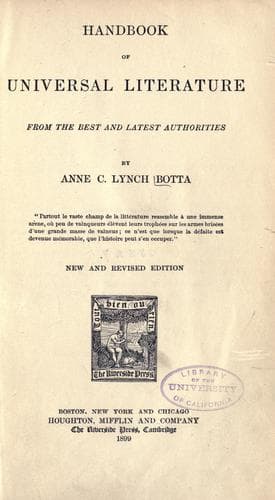
Handbook of Universal Literature, From the Best and Latest AuthoritiesBotta, Anne C. Lynch (Anne Charlotte Lynch)
History
Handbook of Universal Literature, From the Best and Latest Authorities
Botta, Anne C. Lynch (Anne Charlotte Lynch)
Literature -- History and criticism
10. GRAMMARIANS.--Towards the conclusion of this literary period a great
increase took place in the numbers of those learned men whom the Romans at
first termed _literati_, but afterwards, following the custom of the
Greeks, grammarians. To them literature was under great obligations.
Although few of them were authors, and all of them possessed acquired
learning rather than original genius, they exercised a powerful influence
over the public mind as professors, lecturers, critics, and schoolmasters.
By them the youths of the best families not only were imbued with a taste
for Greek philosophy and poetry, but were also taught to appreciate the
literature of their own country. Livius Andronicus and Ennius may be
placed at the head of this class, followed by Crates Mallotes, C. Octavius
Lampadio, Laelius, Archelaus, and others, most of whom were emancipated
slaves, either from Greece or from other foreign countries.
PERIOD SECOND.
FROM THE AGE OF CICERO TO THE DEATH OF AUGUSTUS (74 B.C.-14 A.D.)
1. DEVELOPMENT OF THE ROMAN LITERATURE.--Latin literature, at first rude,
and, for five centuries, unable to reach any high excellence, was, as we
have seen, gradually developed by the example and tendency of the Greek
mind, which moulded Roman civilization anew. The earliest Latin poets,
historians, and grammarians were Greeks. The metre which was brought to
such perfection by the Latin poets was formed from the Greek, and the
Latin language more and more assimilated to the Hellenic tongue.
As civilization advanced, the rude literature of Rome was compared with
the great monuments of Greek genius, their superiority was acknowledged,
and the study of them encouraged. The Roman youth not only attended the
schools of the Greeks, in Rome, but their education was considered
incomplete, unless they repaired to those of Athens, Rhodes, and Mytilene.
Thus, whatever of national character existed in the literature was
gradually obliterated, and what it gained in harmony and finish it lost in
originality. The Roman writers imitated more particularly the writers of
the Alexandrian school, who, being more artificial, were more congenial
than the great writers of the age of Pericles.
Roman genius, serious, majestic, and perhaps more original than at a later
period, was manifest even at the time of the Punic wars, but it had not
yet taken form; and while thought was vigorous and powerful, expression
remained weak and uncertain. But, under the Greek influence, and aided by
the vigor imparted by free institutions, the union of thought and form was
at length consummated, and the literature reached its culminating point in
the great Roman orator. The fruits which had grown and matured in the
centuries preceding were gathered by Augustus; but the influences that
contributed to the splendor of his age belong rather to the republic than
the empire, and with the fall of the liberties of Rome, Roman literature
declined.
Public-domain text, read in full here on John Shaqi.
Reviews
Reviews
No reviews yet
Be the first to share your thoughts on this work.
Elsewhere in the archive
Join the Discussion
Join the discussion
Sign in to leave a comment or review.
Sign InorCreate an account