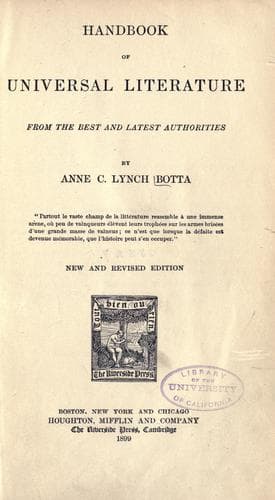
Handbook of Universal Literature, From the Best and Latest AuthoritiesBotta, Anne C. Lynch (Anne Charlotte Lynch)
History
Handbook of Universal Literature, From the Best and Latest Authorities
Botta, Anne C. Lynch (Anne Charlotte Lynch)
Literature -- History and criticism
The place which Cicero occupies in the history of Roman literature is that
of an orator and philosopher. The effectiveness of his oratory was mainly
owing to his knowledge of the human heart, and of the national
peculiarities of his countrymen. Its charm was owing to his extensive
acquaintance with the stores of literature and philosophy, which his
sprightly wit moulded at will; to the varied learning, which his
unpedantic mind made so pleasant and popular; and to his fund of
illustration, at once interesting and convincing. He carried his hearers
with him; senate, judges, and people understood his arguments, and felt
his passionate appeals. Compared with the dignified energy and majestic
vigor of Demosthenes, the Asiatic exuberance of some of his orations may
be fatiguing to the more sober and chaste taste of modern scholars; but in
order to form a just appreciation, we must transport ourselves mentally to
the excitements of the thronged forum, to the senate, composed of
statesmen and warriors in the prime of life, maddened with the party-
spirit of revolutionary times. Viewed in this light, his most florid
passages will appear free from affectation--the natural flow of a speaker
carried away with the torrent of his enthusiasm. Among his numerous
orations, in which, according to the criticisms of Quintilian, he combined
the force of Demosthenes, the copiousness of Plato, and the elegance of
Isocrates, we mention the six celebrated Verrian harangues, which are
considered masterpieces of Tullian eloquence. In the speech for the poet
Archias, he had evidently expended all his resources of art, taste, and
skill; and his oration in defense of Milo, for force, pathos, and the
externals of eloquence, deserves to be reckoned among his most wonderful
efforts. The oratory of Cicero was essentially judicial; even his
political orations are rather judicial than deliberative. He was not born
for a politician; he did not possess that analytical character of mind
which penetrates into the remote causes of human action, nor the
synthetical power which enables a man to follow them out to their farthest
consequences. Of the three qualities necessary for a statesman, he
possessed only two,--honesty and patriotism; he had not political wisdom.
Hence, in the finest specimens of his political orations, his
Catilinarians and Philippics, we look in vain for the calm, practical
weighing of the subject which is necessary in addressing a deliberative
assembly. Nevertheless, so irresistible was the influence which he
exercised upon the minds of his hearers, that all his political speeches
were triumphs. His panegyric on Pompey carried his appointment as
commander-in-chief of the armies of the East; he crushed in Catiline one
of the most formidable traitors that had ever menaced the safety of the
republic, and Antony's fall followed the complete exposure of his
debauchery in private life, and the factiousness of his public career.
Public-domain text, read in full here on John Shaqi.
Reviews
Reviews
No reviews yet
Be the first to share your thoughts on this work.
Elsewhere in the archive
Join the Discussion
Join the discussion
Sign in to leave a comment or review.
Sign InorCreate an account