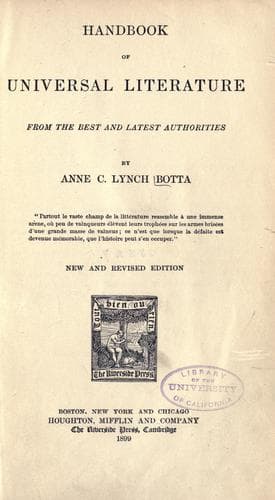
Handbook of Universal Literature, From the Best and Latest AuthoritiesBotta, Anne C. Lynch (Anne Charlotte Lynch)
History
Handbook of Universal Literature, From the Best and Latest Authorities
Botta, Anne C. Lynch (Anne Charlotte Lynch)
Literature -- History and criticism
In his rhetorical works, Cicero left a legacy of practical instruction to
posterity. The treatise "On Invention" is merely interesting as the
juvenile production of a future great man. "The Orator," "Brutus, or the
illustrious Orators," and "The Orator to Marius Brutus," are the results
of his matured experience. They form together one series, in which the
principles are laid down, and their development carried out and
illustrated; and in the "Orator" he places before the eyes of Brutus the
model of ideal perfection. In his treatment of that subject, he shows a
mind imbued with the spirit of Plato; he invests it with dramatic
interest, and transports the reader into the scene which he so graphically
describes.
Roman philosophy was neither the result of original investigation, nor the
gradual development of the Greek system. It arose rather from a study of
ancient philosophical literature, than from an emanation of philosophical
principles. It consisted in a kind of eclecticism with an ethical
tendency, bringing together doctrines and opinions scattered over a wide
field in reference to the political and social relations of man. Greek
philosophy was probably first introduced into Rome 166 B.C. But although
the Romans could appreciate the majestic dignity and poetical beauty of
the style of Plato, they were not equal to the task of penetrating his
hidden meaning; neither did the peripatetic doctrines meet with much
favor. The philosophical system which first arrested the attention of the
Romans, and gained an influence over their minds, was the Epicurean. That
of the Stoics also, the severe principles of which were in harmony with
the stern old Roman virtues, had distinguished disciples. The part which
Cicero's character qualified him to perform in the philosophical
instruction of his countrymen was scarcely that of a guide; he could give
them a lively interest in the subject, but he could not mould and form
their belief, and train them in the work of original investigation. Not
being devoutly attached to any system of philosophical belief, he would be
cautious of offending the philosophical prejudices of others. He was
essentially an eclectic in accumulating stores of Greek erudition, while
his mind had a tendency, in the midst of a variety of inconsistent
doctrines, to leave the conclusion undetermined. He brought everything to
a practical standard; he admired the exalted purity of stoical morality,
but he feared that it was impractical. He believed in the existence of one
supreme creator, in his spiritual nature, and the immortality of the soul;
but his belief was rather the result of instinctive conviction, than of
proof derived from philosophy.
Public-domain text, read in full here on John Shaqi.
Reviews
Reviews
No reviews yet
Be the first to share your thoughts on this work.
Elsewhere in the archive
Join the Discussion
Join the discussion
Sign in to leave a comment or review.
Sign InorCreate an account