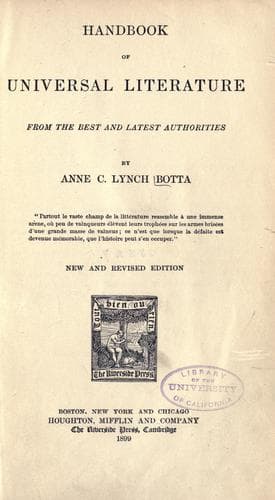
Handbook of Universal Literature, From the Best and Latest AuthoritiesBotta, Anne C. Lynch (Anne Charlotte Lynch)
History
Handbook of Universal Literature, From the Best and Latest Authorities
Botta, Anne C. Lynch (Anne Charlotte Lynch)
Literature -- History and criticism
The study of Cicero's philosophical works is invaluable, in order to
understand the minds of those who came after him. Not only all Roman
philosophy after his time, but a great part of that of the Middle Ages,
was Greek philosophy filtered through Latin, and mainly founded on that of
Cicero. Among his works on speculative philosophy are "The Academics, or a
history and defense of the belief of the new Academy;" "Dialogues on the
Supreme Good, the end of all moral action;" "The Tusculan Disputations,"
containing five treatises on the fear of death, the endurance of pain,
power of wisdom over sorrow, the morbid passions, and the relation of
virtue to happiness. His moral philosophy comprehends the "Duties," a
stoical treatise on moral obligations, and the unequaled little essays on
"Friendship and Old Age." His political works are "The Republic" and "The
Law;" but these remains are fragmentary.
The extent of Cicero's correspondence is almost incredible. Even those
epistles which remain number more than eight hundred. In them we find the
eloquence of the heart, not of the rhetorical school. They are models of
pure Latinity, elegant without stiffness, the natural outpourings of a
mind which could not give birth to an ungraceful idea. In his letters to
Atticus he lays bare the secret of his heart; he trusts his life in his
hands; he is not only his friend but his confidant, his second self. In
the letters of Cicero we have the description of the period of Roman
history, and the portrait of the inner life of Roman society in his day.
8. HISTORY.--In their historical literature the Romans exhibited a
faithful transcript of their mind and character. History at once gratified
their patriotism, and its investigations were in accordance with their
love of the real and the practical. In this department, they were enabled
to emulate the Greeks and to be their rivals, and sometimes their
superiors. The elegant simplicity of Caesar is as attractive as that of
Herodotus; none of the Greek historians surpasses Livy in talent for the
picturesque and in the charm with which he invests his spirited and living
stories; while for condensation of thought, terseness of expression, and
political and philosophical acumen, Tacitus is not inferior to Thucydides.
The catalogue of Roman historians contains many writers whose works are
lost; such as L. Lucretius, the friend and correspondent of Cicero, L.
Lucullus, the illustrious conqueror of Mithridates, and Cornelius Nepos,
of whom only one work was preserved, the "Lives of Eminent Generals." The
authenticity of this work is, however, disputed. But at the head of this
department, as the great representatives of Roman history, stand Julius
Caesar, Sallust, Livy, and Tacitus, all of whom, except the last, belong
to the Augustan age.
Public-domain text, read in full here on John Shaqi.
Reviews
Reviews
No reviews yet
Be the first to share your thoughts on this work.
Elsewhere in the archive
Join the Discussion
Join the discussion
Sign in to leave a comment or review.
Sign InorCreate an account