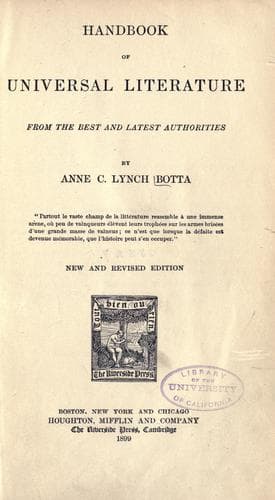
Handbook of Universal Literature, From the Best and Latest AuthoritiesBotta, Anne C. Lynch (Anne Charlotte Lynch)
History
Handbook of Universal Literature, From the Best and Latest Authorities
Botta, Anne C. Lynch (Anne Charlotte Lynch)
Literature -- History and criticism
Julius Caesar (100-44 B.C.) was descended from one of the oldest among the
patrician families of Rome. He attached himself to the popular party, and
his good taste, great tact, and pleasing manners contributed, together
with his talents, to insure his popularity. He became a soldier in the
nineteenth year of his age, and hence his works display all the best
qualities which are fostered by a military education--frankness,
simplicity, and brevity. His earliest literary triumph was as an orator,
and, according to Quintilian, he was a worthy rival of Cicero. When he
obtained the office of Pontifex Maximus, he diligently examined the
history and nature of the Roman belief in augury, and published his
investigations. When his career as a military commander began, whatever
leisure his duties permitted him to enjoy he devoted to the composition of
his memoirs, or commentaries of the Gallic and civil wars. He wrote, also,
some minor works on different subjects, and he left behind him various
letters, some of which are extant.
But by far the most important of the works of Caesar is his
"Commentaries," which have come down to us in a tolerably perfect state.
They are sketches taken on the spot, in the midst of action, while the
mind was full, and they have all the graphic power of a master-mind and
the vigorous touches of a master-hand. The Commentaries are the materials
for history, notes jotted down for future historians. The very faults
which may justly be found with the style of Caesar are such as reflect the
man himself. The majesty of his character consists chiefly in the
imperturbable calmness and equanimity of his temper; he had no sudden
bursts of energy and alternations of passion and inactivity. The elevation
of his character was a high one, but it was a level table-land. This
calmness and equability pervades his writings, and for this reason they
have been thought to want life and energy. The beauty of his language is,
as Cicero says, statuesque rather than picturesque. Simple and severe, it
conveys the idea of perfect and well-proportioned beauty, while it
banishes all thoughts of human passion. In relating his own deeds, he does
not strive to add to his own reputation by detracting from the merits of
those who served under him. He is honest, generous, and candid, not only
towards them, but also towards his brave enemies. He recounts his
successes without pretension or arrogance, though he has evidently no
objection to be the hero of his own tale. His Commentaries are not
confessions, although he is the subject of them; not a record of a
weakness appears, nor even a defect, except that which the Romans would
readily forgive, cruelty. His savage waste of human life he recounts with
perfect self-complacency. Vanity, the crowning error in his career as a
statesman, though hidden by the reserve with which he speaks of himself,
sometimes discovers itself in the historian.
Public-domain text, read in full here on John Shaqi.
Reviews
Reviews
No reviews yet
Be the first to share your thoughts on this work.
Elsewhere in the archive
Join the Discussion
Join the discussion
Sign in to leave a comment or review.
Sign InorCreate an account