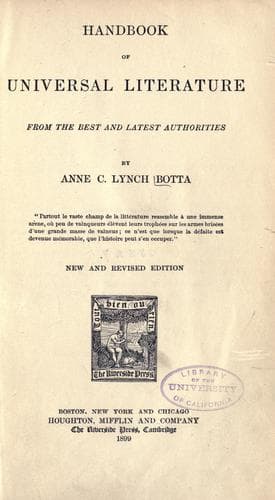
Handbook of Universal Literature, From the Best and Latest AuthoritiesBotta, Anne C. Lynch (Anne Charlotte Lynch)
History
Handbook of Universal Literature, From the Best and Latest Authorities
Botta, Anne C. Lynch (Anne Charlotte Lynch)
Literature -- History and criticism
The natural history of Pliny is an unequaled monument of studious
diligence and persevering industry. It consists of thirty-seven books, and
contains 20,000 facts (as he believed them to be) connected with nature
and art, the result not of original research, but, as he honestly
confessed, culled from the labors of other men.
Owing to the extent of his reading, his love of the marvelous, and his
want of judgment in comparing and selecting, he does not present us with a
correct view of the science of his own age. He reproduces errors evidently
obsolete and inconsistent with facts and theories which had afterwards
replaced them. With him, mythological traditions appeared to have almost
the same authority as modern discoveries; the earth teems with monsters,
not exceptions to the regular order of nature, but specimens of her
ingenuity. His peculiar pantheistic belief prepared him to consider
nothing incredible, and his temper inclined him to admit all that was
credible as true.
He tells us of men whose feet were turned backwards, of others whose feet
were so large as to shade them when they lay in the sun; others without
mouths, who fed on the fragrance of fruits and flowers. Among the lower
animals, he enumerates horned horses furnished with wings; the mantichora,
with the face of a man, three rows of teeth, a lion's body, and a
scorpion's tail; the basilisk, whose very glance is fatal; and an insect
which cannot live except in the midst of the flames. But notwithstanding
his credulity and his want of judgment, this elaborate work contains many
valuable truths and much entertaining information. The prevailing
character of his philosophical belief, though tinctured with the stoicism
of the day, is querulous and melancholy. Believing that nature is an all-
powerful principle, and the universe instinct with deity, he saw more of
evil than of good in the divine dispensation, and the result was a gloomy
and discontented pantheism.
Celsus probably lived in the reign of Tiberius. He was the author of many
works, on various subjects, of which one, in eight books, on medicine, is
now extant. The independence of his views, the practical, as well as the
scientific nature of his instructions, and above all, his knowledge of
surgery, and his clear exposition of surgical operations, have given his
work great authority; the highest testimony is borne to its merits by the
fact of its being used as a text-book, even in the present advanced state
of medical science. The taste of the age in which he lived turned his
attention also to polite literature, and to that may be ascribed the
Augustan purity of his style.
Pomponius Mela lived in the reign of Claudius. He is considered as the
representative of the Roman geographers. Though his book, "The Place of
the World," is but an epitome of former treatises, it is interesting for
the simplicity of its style and the purity of its language.
Public-domain text, read in full here on John Shaqi.
Reviews
Reviews
No reviews yet
Be the first to share your thoughts on this work.
Elsewhere in the archive
Join the Discussion
Join the discussion
Sign in to leave a comment or review.
Sign InorCreate an account