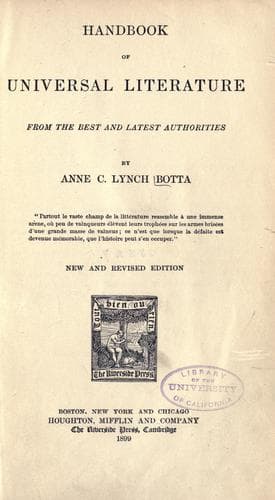
Handbook of Universal Literature, From the Best and Latest AuthoritiesBotta, Anne C. Lynch (Anne Charlotte Lynch)
History
Handbook of Universal Literature, From the Best and Latest Authorities
Botta, Anne C. Lynch (Anne Charlotte Lynch)
Literature -- History and criticism
Columella flourished in the reigns of Claudius and Nero. He is author of
an agricultural work, "De Re Rustica," in which he gives, in smooth and
fluent, though somewhat too diffuse a style, the fullest and completest
information on practical agriculture among the Romans in the first century
of the Christian era.
Frontinus (fl. 78 A.D.) left two valuable works, one on military tactics,
the other a descriptive architectural treatise on those wonderful
monuments of Roman art, the aqueducts. Besides these, there are extant
fragments of other works on surveying, and on the laws and customs
relating to landed property, which assign Frontinus an important place in
the estimation of the students of Roman history.
9. ROMAN LITERATURE FROM HADRIAN TO THEODORIC (138-526 A.D.).--From the
death of Augustus, Roman literature had gradually declined, and though it
shone forth for a time with classic radiance in the writings of Persius,
Juvenal, Quintilian, Tacitus, and the Plinies, with the death of freedom,
the extinction of patriotism, and the decay of the national spirit,
nothing could avert its fall. Poetry had become declamation; history had
degenerated either into fulsome panegyric or the fleshless skeletons of
epitomes; and at length the Romans seemed to disdain the use of their
native tongue, and wrote again in Greek, as they had in the infancy of the
national literature. The Emperor Hadrian resided long at Athens, and
became imbued with a taste and admiration for Greek; and thus the
literature of Rome became Hellenized. From this epoch the term classical
can no longer be applied to it, for it no longer retained its purity. To
Greek influence succeeded the still more corrupting one of foreign
nations. With the death of Nerva, the uninterrupted succession of emperors
of Roman or Italian birth ceased. Trajan himself was a Spaniard, and after
him not only foreigners of every European race, but even Orientals and
Africans were invested with the imperial purple, and the huge empire over
which they ruled was one unwieldy mass of heterogeneous materials. The
literary influence of the capital was not felt in the interior portions of
the Roman dominions. Schools were established in the very heart of nations
just emerging from barbarism; and though the blessings of civilization and
intellectual culture were thus distributed far and wide, still literary
taste, as it flowed through the minds of foreigners, became corrupted, and
the language of the imperial city, exposed to the infecting contact of
barbarous idioms, lost its purity.
The Latin authors of this age were numerous, but few had taste to
appreciate and imitate the literature of the Augustan age. They may be
classified according to their departments of poetry, history, grammar and
oratory, philosophy and science.
Public-domain text, read in full here on John Shaqi.
Reviews
Reviews
No reviews yet
Be the first to share your thoughts on this work.
Elsewhere in the archive
Join the Discussion
Join the discussion
Sign in to leave a comment or review.
Sign InorCreate an account