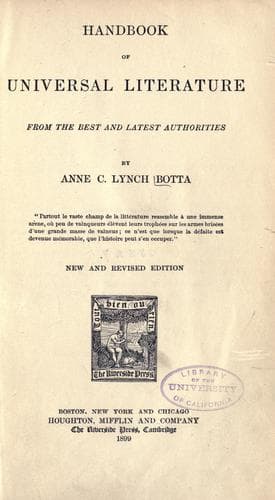
Handbook of Universal Literature, From the Best and Latest AuthoritiesBotta, Anne C. Lynch (Anne Charlotte Lynch)
History
Handbook of Universal Literature, From the Best and Latest Authorities
Botta, Anne C. Lynch (Anne Charlotte Lynch)
Literature -- History and criticism
The brightest star of the poetry of this period was Claudian (365-404
A.D.), in whom the graceful imagination of classical antiquity seems to
have revived. He enjoyed the patronage of Stilicho, the guardian and
minister of Honorius, and in the praise and honor of him and of his pupil,
he wrote "The Rape of Proserpine," the "War of the Giants," and several
other poems.
His descriptions indicate a rich and powerful imagination, but, neglecting
substance for form, his style is often declamatory and affected. Among the
earliest authors of Christian hymns were Hilarius and Prudentius, Those of
the former were expressly designed to be sung, and are said to have been
set to music by the author himself. Prudentius (fl. 348 A.D.) wrote many
hymns and poems in defense of the Christian faith, more distinguished for
their pious and devotional character than for their lyric sublimity or
parity of language. To this age belong also the hymns of Damasus and of
Ambrose.
Among the historians are Flavius Eutropius, who lived in the fourth
century, and by the direction of the Emperor Valens composed an "Epitome
of Roman History," which was a favorite book in the Middle Ages. Ammianus
Marcellinus, his contemporary, wrote a Roman history in continuation of
Tacitus and Suetonius. Though his style is affected and often rough and
inaccurate, his work is interesting for its digressions and observations.
Severus Sulpicius wrote the history of the Hebrews, and of the four
centuries of the church. His "Sacred History," for its language and style,
is one of the best works of that age.
In the department of oratory may be mentioned Cornelius Fronto, who
flourished under Domitian and Nerva, and was endowed with a rich
imagination and a mind stored with vast erudition in Greek and Latin
literature, Symmachus, distinguished for his opposition to Christianity,
and Cassiodorus, minister and secretary of the Emperor Theodoric.
In the decline of Roman, as of Greek literature, grammarians took the
place of poets and of historians; they commented on and interpreted the
ancient classics, and transmitted to us valuable information concerning
the Augustan writers. Among the most important works of this kind are the
"Attic Nights" of Gellius, who was born in Rome, and lived under Hadrian
and the Antonines. In this work are preserved many valuable passages of
the classics which would otherwise have been lost. Macrobius, who
flourished in the middle of the fifth century, was the author of different
works in which the doctrines of the Neo-Platonic school are expounded. His
style, however, is very defective.
Public-domain text, read in full here on John Shaqi.
Reviews
Reviews
No reviews yet
Be the first to share your thoughts on this work.
Elsewhere in the archive
Join the Discussion
Join the discussion
Sign in to leave a comment or review.
Sign InorCreate an account