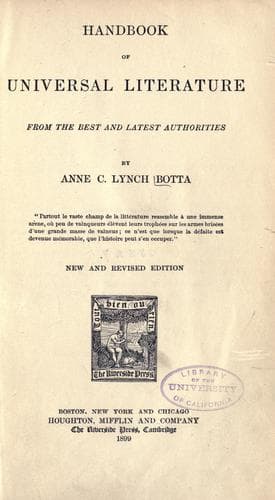
Handbook of Universal Literature, From the Best and Latest AuthoritiesBotta, Anne C. Lynch (Anne Charlotte Lynch)
History
Handbook of Universal Literature, From the Best and Latest Authorities
Botta, Anne C. Lynch (Anne Charlotte Lynch)
Literature -- History and criticism
A striking characteristic of the writings, both in Greek and Latin, of the
last ages of the empire, is the prevalence of principles and opinions
imported from the East. The Neo-Platonic school, imbued with Oriental
mysticism, had diffused the belief in spirits and magic, and the
philosophy of this age was a mixture of ancient wisdom with new
superstitions belonging to the ages of transition between the decadence of
the ancient faith and the development of a new religion. The best
representative of the philosophy of this age is Apuleius, born in Africa
in the reign of Hadrian. After having received his education in Carthage
and Athens, he came to Rome, where he acquired great reputation as a
literary man, and as the possessor of extraordinary supernatural powers.
To this extensive philosophical knowledge and immense erudition he united
great polish of manner and remarkable beauty of person. He wrote much on
philosophy; but his most important work is a romance known as
"Metamorphoses, or the Golden Ass," containing his philosophical and
mystic doctrines. In this book, the object of which is to encourage the
belief in mysticism, the writer describes the transformation of a young
man into an ass, who is allowed to take his primitive human form only
through a knowledge of the mysteries of Isis. The story is well told, and
the romance is full of interest and sprightliness; but its style is
incorrect, florid, and bombastic.
Boethius (470-524), the last of the Roman philosophers, was the descendant
of an illustrious family. He made Greek philosophy the principal object of
his meditations. He was raised to the highest honors and offices in the
empire by Theodoric, but finally, through the artifices of enemies who
envied his reputation, he lost the favor of his patron, was imprisoned,
and at length beheaded. Of his numerous works, founded on the peripatetic
philosophy, that which has gained him the greatest celebrity is entitled
"On the Consolations of Philosophy," composed while he was in prison. It
is in the form of a dialogue, in which philosophy appears to console him
with the idea of Divine Providence. The poetical part of the book is
written with elegance and grace, and his prose, though not pure, is fluent
and full of tranquil dignity. The work of Boethius, which is known in all
modern languages, was translated into Anglo-Saxon by King Alfred, 900 A.D.
The fathers of the church followed more particularly the philosophy of
Plato, which was united and adapted to Christianity. St. Augustine is the
most illustrious among the Christian Platonists.
Public-domain text, read in full here on John Shaqi.
Reviews
Reviews
No reviews yet
Be the first to share your thoughts on this work.
Elsewhere in the archive