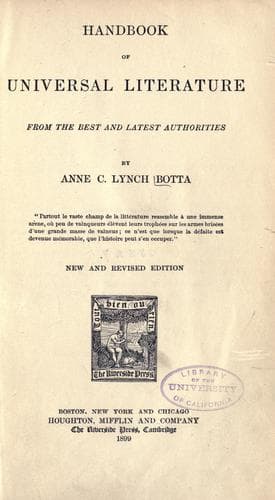
Handbook of Universal Literature, From the Best and Latest AuthoritiesBotta, Anne C. Lynch (Anne Charlotte Lynch)
History
Handbook of Universal Literature, From the Best and Latest Authorities
Botta, Anne C. Lynch (Anne Charlotte Lynch)
Literature -- History and criticism
What Bagdad was to Asia, Cordova was to Europe, where, particularly in the
tenth and eleventh centuries, the Arabs were the pillars of literature. At
this period, when learning found scarcely anywhere either rest or
encouragement, the Arabians were employed in collecting and diffusing it
in the three great divisions of the world. Students traveled from France
and other European countries to the Arabian schools in Spain, particularly
to learn medicine and mathematics. Besides the academy at Cordova, there
were established fourteen others in different parts of Spain, exclusive of
the higher schools. The Arabians made the most rapid advancement in all
the departments of learning, especially in arithmetic, geometry, and
astronomy. In the various cities of Spain, seventy libraries were opened
for public instruction at the period when all the rest of Europe, without
books, without learning, without cultivation, was plunged in the most
disgraceful ignorance. The number of Arabic authors which Spain produced
was so prodigious, that many Arabian bibliographers wrote learned
treatises on the authors born in particular towns, or on those among the
Spaniards who devoted themselves to a single branch of study, as
philosophy, medicine, mathematics, or poetry. Thus, throughout the vast
extent of the Arabian empire, the progress of letters had followed that of
arms, and for five centuries this literature preserved all its brilliancy.
5. GRAMMAR AND RHETORIC.--The perfection of the language was one of the
first objects of the Arabian scholars, and from the rival schools of Cufa
and Bassora a number of distinguished men proceeded, who analyzed with the
greatest subtlety all its rules and aided in perfecting it. As early as in
the age of Ali, the fourth Caliph, Arabian literature boasted of a number
of scientific grammarians. Prosody and the metric art were reduced to
systems. Dictionaries of the language were composed, some of which are
highly esteemed at the present day. Among these may be mentioned the "Al
Sehah," or Purity, and "El Kamus," or the Ocean, which is considered the
best dictionary of the Arabian language. The study of rhetoric was united
to that of grammar, and the most celebrated works of the Greeks on this
art were translated and adapted to the Arabic. After the age of Mohammed
and his immediate successors, popular eloquence was no longer cultivated.
Eastern despotism having supplanted the liberty of the desert, the heads
of the state or army regarded it beneath them to harangue the people or
the soldiers; they called upon them only for obedience. But though
political eloquence was of short duration among the Arabians, on the other
hand they were the inventors of that species of rhetoric most cultivated
at the present day, that of the academy and the pulpit. Their philosophers
in these learned assemblies displayed all the measured harmony of which
their language was susceptible. Mohammed had ordained that his faith
Public-domain text, read in full here on John Shaqi.
Reviews
Reviews
No reviews yet
Be the first to share your thoughts on this work.
Elsewhere in the archive
Join the Discussion
Join the discussion
Sign in to leave a comment or review.
Sign InorCreate an account