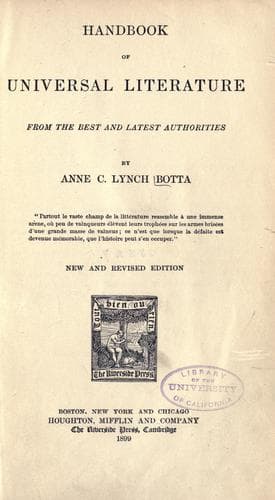
Handbook of Universal Literature, From the Best and Latest AuthoritiesBotta, Anne C. Lynch (Anne Charlotte Lynch)
History
Handbook of Universal Literature, From the Best and Latest Authorities
Botta, Anne C. Lynch (Anne Charlotte Lynch)
Literature -- History and criticism
should be preached in the mosques;--many of the harangues of these sacred
orators are still preserved in the Escurial, and the style of them is very
similar to that of the Christian orators.
6. POETRY.--Poetry still more than eloquence was the favorite occupation
of the Arabians from their origin as a nation. It is said that this people
alone have produced more poets than all others united. Mohammed himself,
as well as some of his first companions, cultivated this art, but it was
under Haroun al Raschid and his successor, Al Mamoun, and more especially
under the Ommyïades of Spain that Arabic poetry attained its highest
splendor. But the ancient impetuosity of expression, the passionate
feeling, and the spirit of individual independence no longer characterized
the productions of this period, nor is there among the numerous
constellations of Arabic poets any star of distinguished magnitude. With
the exception of Mohammed and a few of the Saracen conquerors and
sovereigns, there is scarcely an individual of this nation whose name is
familiar to the nations of Christendom.
The Arabians possess many heroic poems composed for the purpose of
celebrating the praises of distinguished men, and of animating the courage
of their soldiers. They do not, however, boast of any epics; their poetry
is entirely lyric and didactic. They have been inexhaustible in their love
poems, their elegies, their moral verses,--among which their fables may be
reckoned,--their eulogistic, satirical, descriptive, and above all, their
didactic poems, which have graced even the most abstruse science, as
grammar, rhetoric, and arithmetic. But among all their poems, the
catalogue alone of which, in the Escurial, consists of twenty-four
volumes, there is not a single epic, comedy, or tragedy.
In those branches of poetry which they cultivated they displayed
surprising subtlety and great refinement of thought, but the fame of their
compositions rests, in some degree, on their bold metaphors, their
extravagant allegories, and their excessive hyperboles. The Arabs despised
the poetry of the Greeks, which appeared to them timid, cold, and
constrained, and among all the books, which, with almost superstitious
veneration, they borrowed from them, there is scarcely a single poem which
they judged worthy of translation. The object of the Arabian poets was to
make a brilliant use of the boldest and most gigantic images, and to
astonish the reader by the abruptness of their expressions. They burdened
their compositions with riches, under the idea that nothing which was
beautiful could be superfluous. They neglected natural sentiment, and the
more they could multiply the ornaments of art, the more admirable in their
eyes did the work appear.
Public-domain text, read in full here on John Shaqi.
Reviews
Reviews
No reviews yet
Be the first to share your thoughts on this work.
Elsewhere in the archive
Join the Discussion
Join the discussion
Sign in to leave a comment or review.
Sign InorCreate an account