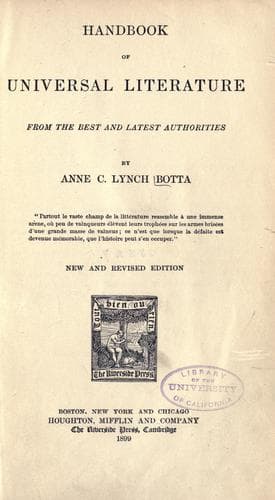
Handbook of Universal Literature, From the Best and Latest AuthoritiesBotta, Anne C. Lynch (Anne Charlotte Lynch)
History
Handbook of Universal Literature, From the Best and Latest Authorities
Botta, Anne C. Lynch (Anne Charlotte Lynch)
Literature -- History and criticism
The nations who possessed a classical poetry, in imitating nature, had
discovered the use of the epic and the drama, in which the poet endeavors
to express the true language of the human heart. The people of the East,
with the exception of the Hindus, never made this attempt--their poetry is
entirely lyric; but under whatever name it may be known, it is always
found to be the language of the passions. The poetry of the Arabians is
rhymed like our own, and the rhyming is often carried still farther in the
construction of the verse, while the uniformity of sound is frequently
echoed throughout the whole expression. The collection made by Aboul Teman
(fl. 845 A.D.) containing the Arabian poems of the age anterior to
Mohammed, and that of Taoleti, which embraces the poems of the subsequent
periods, are considered the richest and most complete anthologies of
Arabian poetry. Montanebbi, a poet who lived about 1050, has been compared
to the Persian Hafiz.
7. THE ARABIAN TALES.--If the Arabs have neither the epic nor the drama,
they have been, on the other hand, the inventors of a style of composition
which is related to the epic, and which supplies among them the place of
the drama. We owe to them those tales, the conception of which is so
brilliant and the imagination so rich and varied: tales which have been
the delight of our infancy, and which at a more advanced age we can never
read without feeling their enchantment anew. Every one is acquainted with
the "Arabian Nights Entertainments;" but in our translation we possess but
a very small part of the Arabian collection, which is not confined merely
to books, but forms the treasure of a numerous class of men and women,
who, throughout the East, find a livelihood in reciting these tales to
crowds, who delight to forget the present, in the pleasing dreams of
imagination. In the coffee-houses of the Levant, one of these men will
gather a silent crowd around him, and picture to his audience those
brilliant and fantastic visions which are the patrimony of Eastern
imaginations. The public squares abound with men of this class, and their
recitations supply the place of our dramatic representations. The
physicians frequently recommend them to their patients in order to soothe
pain, to calm agitation, or to produce sleep; and these story-tellers,
accustomed to sickness, modulate their voices, soften their tones, and
gently suspend them as sleep steals over the sufferer.
Public-domain text, read in full here on John Shaqi.
Reviews
Reviews
No reviews yet
Be the first to share your thoughts on this work.
Elsewhere in the archive
Join the Discussion
Join the discussion
Sign in to leave a comment or review.
Sign InorCreate an account