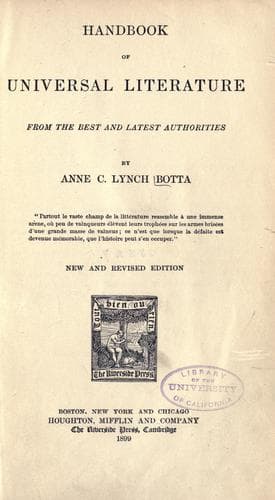
Handbook of Universal Literature, From the Best and Latest AuthoritiesBotta, Anne C. Lynch (Anne Charlotte Lynch)
History
Handbook of Universal Literature, From the Best and Latest Authorities
Botta, Anne C. Lynch (Anne Charlotte Lynch)
Literature -- History and criticism
The imagination of the Arabs in these tales is easily distinguished from
that of the chivalric nations. The supernatural world is the same in both,
but the moral world is different. The Arabian tales, like the romances of
chivalry, convey us to the fairy realms, but the human personages which
they introduce are very dissimilar. They had their birth after the
Arabians had devoted themselves to commerce, literature, and the arts, and
we recognize in them the style of a mercantile people, as we do that of a
warlike nation in the romances of chivalry. Valor and military
achievements here inspire terror but no enthusiasm, and on this account
the Arabian tales are often less noble and heroic than we usually expect
in compositions of this nature. But, on the other hand, the Arabians are
our masters in the art of producing and sustaining this kind of fiction.
They are the creators of that brilliant mythology of fairies and genii
which extends the bounds of the world, and carries us into the realms of
marvels and prodigies. It is from them that European nations have derived
that intoxication of love, that tenderness and delicacy of sentiment, and
that reverential awe of women, by turns slaves and divinities, which have
operated so powerfully on their chivalrous feelings. We trace their
effects in all the literature of the south, which owes to this cause its
mental character. Many of these tales had separately found their way into
the poetic literature of Europe, long before the translation of the
Arabian Nights. Some are to be met with in the old _fabliaux_, in
Boccaccio, and in Ariosto, and these very tales which have charmed our
infancy, passing from nation to nation through channels frequently
unknown, are now familiar to the memory and form the delight of the
imagination of half the inhabitants of the globe.
The author of the original Arabic work is unknown, as is also the period
at which it was composed. It was first introduced into Europe from Syria,
where it was obtained, in the latter part of the seventeenth century, by
Galland, a French traveler, who was sent to the East by the celebrated
Colbert, to collect manuscripts, and by him first translated and
published.
Public-domain text, read in full here on John Shaqi.
Reviews
Reviews
No reviews yet
Be the first to share your thoughts on this work.
Elsewhere in the archive
Join the Discussion
Join the discussion
Sign in to leave a comment or review.
Sign InorCreate an account