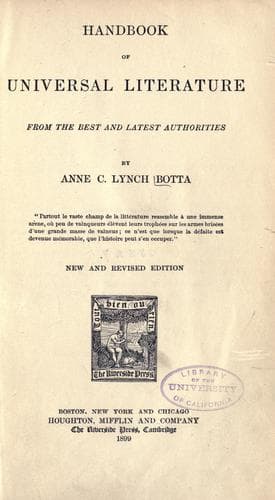
Handbook of Universal Literature, From the Best and Latest AuthoritiesBotta, Anne C. Lynch (Anne Charlotte Lynch)
History
Handbook of Universal Literature, From the Best and Latest Authorities
Botta, Anne C. Lynch (Anne Charlotte Lynch)
Literature -- History and criticism
1. LATIN INFLUENCE.--During the early part of the Middle Ages Latin was
the literary language of Italy, and the aim of the best writers of the
time was to restore Roman culture. The Gothic kingdom of Ravenna,
established by Theodoric, was the centre of this movement, under the
influence of Cassiodorus, Boethius, and Symmachus. It was due to the
prevailing affection for the memories of Rome, that through all the Dark
Ages the Italian mind kept alive a spirit of freedom unknown in other
countries of Europe, a spirit active, later, in the establishment of the
Italian republics, and showing itself in the heroic resistance of the
communes of Lombardy to the empire of the Hohenstaufens. While the
literatures of other countries were drawn almost exclusively from sacred
and chivalric legends, the Italians devoted themselves to the study of
Roman law and history, to translations from the philosophers of Greece,
and, above all, to the establishment of those great universities which
were so powerful in extending science and culture throughout the
Peninsula.
While the Latin language was used in prose, the poets wrote in Provençal
and in French, and many Italian troubadours appeared at the courts of
Europe.
2. EARLY ITALIAN POETRY AND PROSE.--The French element became gradually
lessened, and towards the close of the thirteenth century there arose the
Tuscan school of lyric poetry, the true beginning of Italian art, of which
Lapo Gianni, Guido Cavalcanti, Cino da Pistoia, and Dante Alighieri were
the masters. It is mainly inspired by love, and takes a popular courtly or
scholastic form. The style of Gianni had many of the faults of his
predecessors. That of Cavalcanti, the friend and precursor of Dante,
showed a tendency to stifle poetic imagery under the dead weight of
philosophy. But the love poems of Cino are so mellow, so sweet, so
musical, that they are only surpassed by those of Dante, who, as the
author of the "Vita Nuova," belongs to this lyric school. In this book he
tells the story of his love for Beatrice, which was from the first a high
idealization in which there was apparently nothing human or earthly.
Everything is super-sensual, aerial, heavenly, and the real Beatrice melts
more and more into the symbolic, passing out of her human nature into the
divine.
Italian prose writing is of a later date, and also succeeded a period when
Italian authors wrote in Latin and French. It consists chiefly of
chronicles, tales, and translations.
Public-domain text, read in full here on John Shaqi.
Reviews
Reviews
No reviews yet
Be the first to share your thoughts on this work.
Elsewhere in the archive
Join the Discussion
Join the discussion
Sign in to leave a comment or review.
Sign InorCreate an account