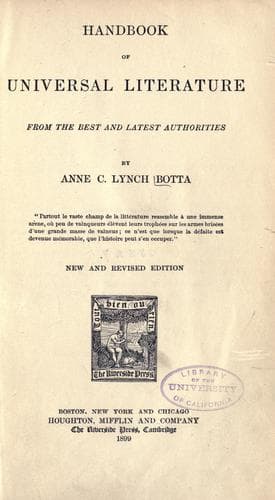
Handbook of Universal Literature, From the Best and Latest AuthoritiesBotta, Anne C. Lynch (Anne Charlotte Lynch)
History
Handbook of Universal Literature, From the Best and Latest Authorities
Botta, Anne C. Lynch (Anne Charlotte Lynch)
Literature -- History and criticism
3. DANTE (1265-1331).--No poet had yet arisen gifted with absolute power
over the empire of the soul; no philosopher had pierced into the depths of
feeling and of thought, when Dante, the greatest name of Italy and the
father of Italian literature, appeared in the might of his genius, and
availing himself of the rude and imperfect materials within his reach,
constructed his magnificent work. Dante was born in Florence, of the noble
family of Alighieri, which was attached to the papal, or Guelph party, in
opposition to the imperial, or Ghibelline. He was but a child when death
deprived him of his father; but his mother took the greatest pains with
his education, placing him under the tuition of Brunetto Latini, and other
masters of eminence. He early made great progress, not only in an
acquaintance with classical literature and politics, but in music,
drawing, horsemanship, and other accomplishments suitable to his station.
As he grew up, he pursued his studies in the universities of Padua,
Bologna, and Paris. He became an accomplished scholar, and at the same
time appeared in public as a gallant and high-bred man of the world. At
the age of twenty-five, he took arms on the side of the Florentine
Guelphs, and distinguished himself in two battles against the Ghibellines
of Arezzo and Pisa. But before Dante was either a student or a soldier, he
had become a lover; and this character, above all others, was impressed
upon him for life. At a May-day festival, when only nine years of age, he
had singled out a girl of his own age, by the name of Bice, or Beatrice,
who thenceforward became the object of his constant and passionate
affection, or the symbol of all human wisdom and perfection. Before his
twenty-fifth year she was separated from him by death, but his passion was
refined, not extinguished by this event; not buried with her body but
translated with her soul, which was its object. On the other hand, the
affection of Beatrice for the poet troubled her spirit amid the bliss of
Paradise, and the visions of the eternal world with which he was favored
were a device of hers for reclaiming him from sin, and preparing him for
everlasting companionship with herself.
Public-domain text, read in full here on John Shaqi.
Reviews
Reviews
No reviews yet
Be the first to share your thoughts on this work.
Elsewhere in the archive
Join the Discussion
Join the discussion
Sign in to leave a comment or review.
Sign InorCreate an account