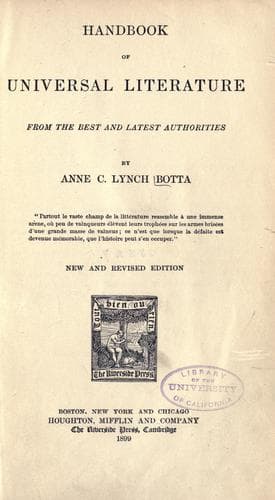
Handbook of Universal Literature, From the Best and Latest AuthoritiesBotta, Anne C. Lynch (Anne Charlotte Lynch)
History
Handbook of Universal Literature, From the Best and Latest Authorities
Botta, Anne C. Lynch (Anne Charlotte Lynch)
Literature -- History and criticism
At the age of thirty-five he was elected prior, or supreme magistrate of
Florence, an honor from which he dates all his subsequent misfortunes.
During his priorship, the citizens were divided into two factions called
the Neri and Bianchi, as bitterly opposed to each other as both had been
to the Ghibellines. In the absence of Dante on an embassy to Rome, a
pretext was found by the Neri, his opponents, for exciting the populace
against him. His dwelling was demolished, his property confiscated,
himself and his friends condemned to perpetual exile, with the provision
that, if taken, they should be burned alive. After a fruitless attempt, by
himself and his party, to surprise Florence, he quitted his companions in
disgust, and passed the remainder of his life in wandering from one court
of Italy to another, eating the bitter bread of dependence, which was
granted him often as an alms. The greater part of his poem was composed
during this period; but it appears that till the end of his life he
continued to retouch the work.
The last and most generous patron of Dante was Guido di Polenta, lord of
Ravenna, and father of Francesca da Rimini, whose fatal love forms one of
the most beautiful episodes of this poem. Polenta treated him, not as a
dependent but as an honored guest, and in a dispute with the Republic of
Venice he employed the poet as his ambassador, to effect a reconciliation;
but he was refused even an audience, and, returning disappointed and
broken-hearted to Ravenna, he died soon after at the age of fifty-six,
having been in exile nineteen years.
His fellow-citizens, who had closed their hearts and their gates against
him while living, now deeply bewailed his death; and, during the two
succeeding centuries, embassy after embassy was vainly sent from Florence
to recover his honored remains. Not long after his death, those who had
exiled him and confiscated his property provided that his poem should be
read and expounded to the people in a church. Boccaccio was appointed to
this professorship. Before the end of the sixteenth century, the "Divine
Comedy" had gone through sixty editions.
Public-domain text, read in full here on John Shaqi.
Reviews
Reviews
No reviews yet
Be the first to share your thoughts on this work.
Elsewhere in the archive
Join the Discussion
Join the discussion
Sign in to leave a comment or review.
Sign InorCreate an account