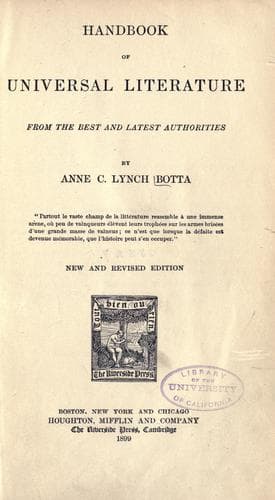
Handbook of Universal Literature, From the Best and Latest AuthoritiesBotta, Anne C. Lynch (Anne Charlotte Lynch)
History
Handbook of Universal Literature, From the Best and Latest Authorities
Botta, Anne C. Lynch (Anne Charlotte Lynch)
Literature -- History and criticism
The Divine Comedy is one of the greatest monuments of human genius. It is
an allegory conceived in the form of a vision, which was the most popular
style of poetry at that age. At the close of the year 1300 Dante
represents himself as lost in a forest at the foot of a hill, near
Jerusalem. He wishes to ascend it, but is prevented by a panther, a lion,
and a she-wolf which beset the way. He is met by Virgil, who tells him
that he is sent by Beatrice as a guide through the realm of shadows, hell,
and purgatory, and that she will afterwards lead him up to heaven. They
pass the gates of hell, and penetrate into the dismal region beyond. This,
as represented by Dante, consists of nine circles, forming an inverted
cone, of the size of the earth, each succeeding circle being lower and
narrower than the former, while Lucifer is chained in the centre and at
the bottom of the dreadful crater. Each circle contains various cavities,
where the punishments vary in proportion to the guilt, and the suffering
increases in intensity as the circles descend and contract. In the first
circle were neither cries nor tears, but the eternal sighs of those who,
having never received Christian baptism, were, according to the poet's
creed, forever excluded from the abodes of bliss. In the next circle,
appropriated to those whose souls had been lost by the indulgence of
guilty love, the poet recognizes the unhappy Francesca da Rimini, whose
history forms one of the most beautiful episodes of the poem. The third
circle includes gluttons; the fourth misers and spendthrifts; each
succeeding circle embracing what the poet deems a deeper shade of guilt,
and inflicting appropriate punishment. The Christian and heathen systems
of theology are here freely interwoven. We have Minos visiting the Stygian
Lake, where heretics are burning; we meet Cerberus and the harpies, and we
accompany the poet across several of the fabulous rivers of Erebus. A
fearful scene appears in the deepest circle of the infernal abodes. Here,
among those who have betrayed their country, and are entombed in eternal
ice, is Count Ugolino, who, by a series of treasons, had made himself
master of Pisa. He is gnawing with savage ferocity the skull of the
archbishop of that state, who had condemned him and his children to die by
starvation. The arch-traitor, Satan, stands fixed in the centre of hell
and of the earth. All the streams of guilt keep flowing back to him as
their source, and from beneath his threefold visage issue six gigantic
wings with which he vainly struggles to raise himself, and thus produces
winds which freeze him more firmly in the marsh.
Public-domain text, read in full here on John Shaqi.
Reviews
Reviews
No reviews yet
Be the first to share your thoughts on this work.
Elsewhere in the archive
Join the Discussion
Join the discussion
Sign in to leave a comment or review.
Sign InorCreate an account