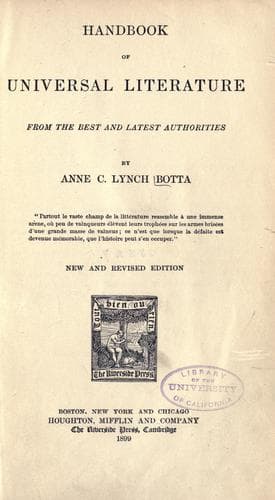
Handbook of Universal Literature, From the Best and Latest AuthoritiesBotta, Anne C. Lynch (Anne Charlotte Lynch)
History
Handbook of Universal Literature, From the Best and Latest Authorities
Botta, Anne C. Lynch (Anne Charlotte Lynch)
Literature -- History and criticism
After leaving the infernal regions, and entering purgatory, they find an
immense cone divided into seven circles, each of which is devoted to the
expiation of one of the seven mortal sins. The proud are overwhelmed with
enormous weights; the envious are clothed in garments of horse-hair, their
eye-lids closed; the choleric are suffocated with smoke; the indolent are
compelled to run about continually; the avaricious are prostrated upon the
earth; epicures are afflicted with hunger and thirst; and the incontinent
expiate their crimes in fire. In this portion of the work, however, while
there is much to admire, there is less to excite and sustain the interest.
On the summit of the purgatorial mountain is the terrestrial paradise,
whence is the only assent to the celestial. Beatrice, the object of his
early and constant affection, descends hither to meet the poet. Virgil
disappears, and she becomes his only guide. She conducts him through the
nine heavens, and makes him acquainted with the great men who, by their
virtuous lives, have deserved the highest enjoyments of eternity. In the
ninth celestial sphere, Dante is favored with a manifestation of divinity,
veiled, however, by three hierarchies of attending angels. He sees the
Virgin Mary, and the saints of the Old and New Testament, and by these
personages, and by Beatrice, all his doubts and difficulties are finally
solved, and the conclusion leaves him absorbed in the beatific vision.
The allegorical meaning of the poem is hidden under the literal one.
Dante, traveling through the invisible world, is a symbol of mankind
aiming at the double object of temporal and eternal happiness. The forest
typifies the civil and religious confusion of society deprived of its two
judges, the pope and the emperor. The three beasts are the powers which
offered the greatest obstacles to Dante's designs, Florence, France, and
the papal court. Virgil represents reason and the empire, and Beatrice
symbolizes the supernatural aid, without which man cannot attain the
supreme end, which is God.
But the merit of the poem is that for the first time classic art is
transferred into a Romance form. Dante is, above all, a great artist.
Whether he describes nature, analyzes passions, curses the vices, or sings
hymns to the virtues, he is always wonderful for the grandeur and delicacy
of his art. He took his materials from mythology, history, and philosophy,
but more especially from his own passions of hatred and love, breathed
into them the breath of genius and produced the greatest work of modern
times.
Public-domain text, read in full here on John Shaqi.
Reviews
Reviews
No reviews yet
Be the first to share your thoughts on this work.
Elsewhere in the archive
Join the Discussion
Join the discussion
Sign in to leave a comment or review.
Sign InorCreate an account