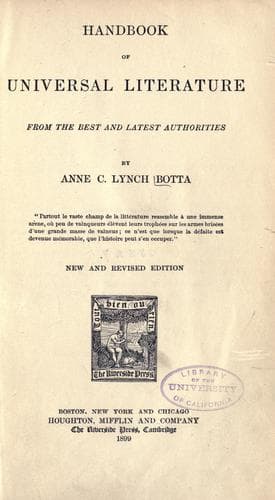
Handbook of Universal Literature, From the Best and Latest AuthoritiesBotta, Anne C. Lynch (Anne Charlotte Lynch)
History
Handbook of Universal Literature, From the Best and Latest Authorities
Botta, Anne C. Lynch (Anne Charlotte Lynch)
Literature -- History and criticism
But towards the close of the fifteenth century the dawn of a new literary
era appeared, which soon shone with meridian light. At this time, the
universities had become more and more the subjects of attention to the
governments; the appointment of eminent professors, and the privileges
connected with these institutions, attracted to them large numbers of
students, and the concourse was often so great that the lectures were
delivered in the churches and in public squares. Those republics which
still existed, and the princes who had risen on the ruins of the more
ephemeral ones, rivaled each other in their patronage of literary men; the
popes, who in the preceding ages had denounced all secular learning, now
became its munificent patrons; and two of them, Nicholas V. and Pius II.,
were themselves scholars of high distinction. The Dukes of Milan, and the
Marquises of Mantua and Ferrara, surrounded themselves in their capitals
with men illustrious in science and letters, and seemed to vie with each
other in the favors which they lavished upon them. In the hitherto free
republic of Florence, which had given birth to Dante, Petrarch, and
Boccaccio, literature found support in a family which, at no distant
period, employed it to augment their power, and to rule the city with an
almost despotic sway. The Medici had been long distinguished for the
wealth they had acquired by commercial enterprise, and for the high
offices which they held in the republic. Cosmo de' Medici had acquired a
degree of power which shook the very foundations of the state. He was
master of the moneyed credit of Europe, and almost the equal of the kings
with whom he negotiated; but in the midst of the projects of his ambition
he opened his palace as an asylum to the scholars and artists of the age,
turned its gardens into an academy, and effected a revolution in
philosophy by setting up the authority of Plato against that of Aristotle.
His banks, which were scattered over Europe, were placed at the service of
literature as well as commerce. His agents abroad sold spices and bought
manuscripts; the vessels which returned to him from Constantinople,
Alexandria, and Smyrna were often laden with volumes in the Greek, Syriac,
and Chaldaic languages. Being banished to Venice, he continued his
protection of letters, and on his return to Florence he devoted himself
more than ever to the cause of literature. In the south of Italy, Alphonso
V., and, indeed, all the sovereigns of that age, pursued the same course,
and chose for their chancellors and ambassadors the same scholars who
educated their sons and expounded the classics in their literary circles.
Public-domain text, read in full here on John Shaqi.
Reviews
Reviews
No reviews yet
Be the first to share your thoughts on this work.
Elsewhere in the archive
Join the Discussion
Join the discussion
Sign in to leave a comment or review.
Sign InorCreate an account