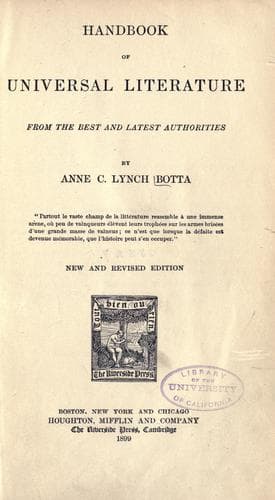
Handbook of Universal Literature, From the Best and Latest AuthoritiesBotta, Anne C. Lynch (Anne Charlotte Lynch)
History
Handbook of Universal Literature, From the Best and Latest Authorities
Botta, Anne C. Lynch (Anne Charlotte Lynch)
Literature -- History and criticism
This patronage, however, was confined to the progress of ancient letters,
while the native literature, instead of redeeming the promise of its
infancy, remained at this time mute and inglorious. Yet the resources of
poets and orators were multiplying a thousand fold. The exalted
characters, the austere laws, the energetic virtues, the graceful
mythology, the thrilling eloquence of antiquity, were annihilating the
puerilities of the old Italian rhymes, and creating purer and nobler
tastes. The clay which was destined for the formation of great men was
undergoing a new process; a fresh mould was cast, the forms at first
appeared lifeless, but ere the end of the fifteenth century the breath of
genius entered into them, and a new era of life began.
PERIOD SECOND.
REVIVAL OF ITALIAN LITERATURE AND ITS SECOND DECLINE (1476-1675).
1. THE CLOSE OF THE FIFTEENTH CENTURY.--The first man who contributed to
the restoration of Italian poetry was Lorenzo de' Medici (1448-1492), the
grandson of Cosmo. In the brilliant society that he gathered around him, a
new era was opened in Italian literature. Himself a poet, he attempted to
restore poetry to the condition in which Petrarch had left it; although
superior in some respects to that poet, he had less power of
versification, less sweetness, and harmony, but his ideas were more
natural, and his style was more simple. He attempted all kinds of poetical
composition, and in all he displayed the versatility of his talents and
the exuberance of his imagination. But to Lorenzo poetry was but an
amusement, scarcely regarded in his brilliant political career. He
concentrated in himself all the power of the republic--he was the arbiter
of the whole political state of Italy, and from the splendor with which he
surrounded himself, and his celebrity, he received the title of Lorenzo
the Magnificent. He continued to collect manuscripts, and to employ
learned men to prepare them for printing. His Platonic Academy extended
its researches into new paths of study. The collection of antique
sculpture, the germ of the gallery of Florence, which had been established
by Cosmo, he enriched, and gave to it a new destination, which was the
occasion of imparting fresh life and vigor to the liberal arts. He
appropriated a part of his gardens to serve as a school for the study of
the antique, and placed his statues, busts, and other models of art in the
shrubberies, terraces, and buildings. Young men were liberally paid for
the copies which they made while pursuing their studies. It was this
institution that kindled the flame of genius in the breast of Michael
Angelo, and to it must be attributed the splendor which was shed by the
fine arts over the close of the fifteenth century, and which extended
rapidly from Florence throughout Italy, and over a great part of Europe.
Among the friends of Lorenzo may be mentioned Pico della Mirandola (1463-
1494), one of the most prominent men of his age, who left in his Latin and
Public-domain text, read in full here on John Shaqi.
Reviews
Reviews
No reviews yet
Be the first to share your thoughts on this work.
Elsewhere in the archive
Join the Discussion
Join the discussion
Sign in to leave a comment or review.
Sign InorCreate an account